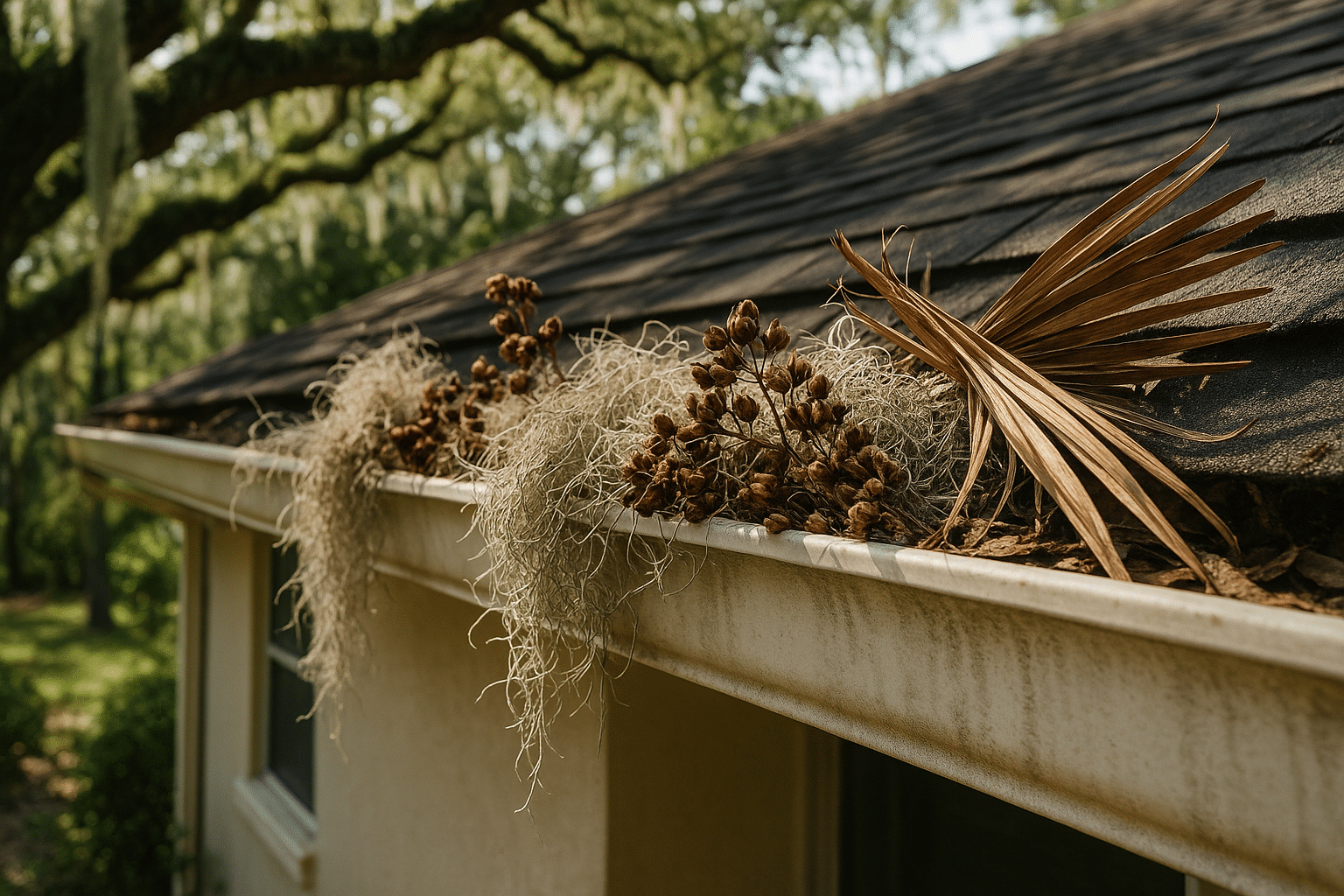
TL;DR: Spanish moss, crape myrtle seed pods, and palm fronds are common Central Florida yard debris that build up in open gutters, trap water, and overload downspouts during summer storms and hurricane season. Each behaves differently in a gutter, but all three lead to the same outcome — overflow, fascia rot, and foundation erosion in our sandy soil — unless gutters are sized, guarded, and maintained for local tree cover.
If you live under live oaks, crape myrtles, or sand pines anywhere between Leesburg and Alachua, you already know the drill: rake the yard, clean the gutters, repeat. But not all yard debris behaves the same way once it lands in a gutter trough. Spanish moss, crape myrtle seed pods, and palm fronds each clog a gutter system in their own way, and each one interacts differently with Central Florida’s sandy soil, high water table, and summer storm pattern.
This guide breaks down what each plant does to your gutters, why it matters more here than almost anywhere else in the country, and what actually stops it.
Spanish Moss: Not a Parasite, But Still a Gutter Problem
First, the biology.
The most common epiphyte seen in Florida is Spanish moss—not a true moss, but a member of the bromeliad family.
The short answer is no: these clingers are not parasitic and really do no damage to branches or bark.
It doesn’t root into your live oaks or laurel oaks, and
the weight of Spanish moss, especially wet, is often blamed for the breakage of limbs, but this is almost never true.
So Spanish moss isn’t killing your trees. But it is absolutely a problem for your gutters, for a simple reason: wind and storms constantly knock loose strands down, and those strands land in the gutter trough along with leaves, pollen, and grit. Once wet, moss behaves like a sponge. It holds water, mats together, and packs into any gap it can find — including the narrow slots in standard louvered or screen-style gutter guards.
In a traditional open gutter, loose moss accumulates at the downspout opening first, since that’s where water funnels and velocity drops. Over a few storms, it forms a dense plug that backs water up the entire run. On a home shaded by mature live oaks around Astor or Astatula, this can happen multiple times per rainy season.
Crape Myrtle Seed Pods: Small, Hard, and Everywhere
Crape myrtles are planted on almost every street and HOA common area in Central Florida for a reason — they bloom through the brutal summer heat and tolerate drought once established. But after flowering, they load up with seed capsules that persist long after the blooms fade.
A large crape myrtle tree, 20 feet tall, can produce a few pounds of seed each year, with roughly 570,000 individual seeds in 2.3 pounds of crape myrtle seed.
Those seed pods start green, dry to a hard brown capsule, and eventually split open and drop. Unlike broad, flat leaves that mat together, crape myrtle pods are small, round, and hard — closer to gravel than mulch when they hit a gutter trough.
That hardness is exactly what makes them dangerous for drainage. They roll into downspout openings and lodge there, creating a blockage that’s harder to flush out with a garden hose than soft leaf debris. Multiply one tree’s seed load across a subdivision median or a line of crape myrtles along a driveway, and you get a steady trickle of pod debris into gutters from late summer through winter.
Palm Fronds: Big, Stiff, and Seasonal
Sabal palms, queen palms, and other ornamental palms common around Lake and Sumter County lakefront properties drop fronds that are nothing like oak leaves or pine needles. A single frond can be several feet long and heavy enough to bend a lightweight gutter hanger on its own. Fronds rarely clog a gutter by filling it gradually — instead, one frond wedges across the trough and becomes a dam that catches everything else that follows: moss, pollen, pods, and silt.
Palm debris tends to spike after wind events, which is exactly when Central Florida gutters are under the most pressure from heavy rain. A frond-blocked gutter during an afternoon thunderstorm can overflow in minutes.
Why This Matters More in Central Florida Than Elsewhere
Three local conditions turn ordinary yard debris into a bigger problem here than in drier or cooler climates:
- Afternoon thunderstorms and hurricane season. Summer storms in Leesburg, Gainesville, and surrounding counties can dump heavy rain in a short burst. A gutter that’s 50% blocked with moss or pods simply can’t move that volume fast enough, and water sheets over the edge instead.
- Sandy soil and fast erosion. When gutters overflow, water doesn’t pool gently — it carves channels through loose, sandy topsoil next to the foundation almost immediately, undermining landscaping and walkways.
- High water tables. Much of Alachua, Marion, Lake, and Sumter Counties sits on a shallow water table. Overflow that saturates soil near the foundation has less room to drain down before it pushes back up against slabs and crawlspaces.
National guidance backs up the basic mechanics here:
gutters clogged with leaves, pine needles, twigs, and dirt cannot move water away from the roof effectively, and during a hurricane, overflowing gutters can send water beneath the shingles, against the siding, or toward the foundation
. That’s true anywhere, but it’s a bigger deal where storm intensity, soil type, and water table all stack the odds against a clogged system.
Pros and Cons of the Common Fixes
Manual cleaning only
Cheapest option, but with live oaks, crape myrtles, and palms all dropping debris at different times of year, twice-a-year cleaning often isn’t enough in heavily wooded Central Florida yards. Gaps between cleanings are exactly when moss mats and pod plugs form.
Screen or louvered guards
Better than nothing, but fine moss strands and small pods can still work through wide-slot screens, and heavy frond debris can sit on top of a screen and block water entry entirely.
Micro-mesh or reverse-curve guards matched to your tree canopy
The most effective long-term fix is matching the guard type to what’s actually falling on your roof. Fine micro-mesh systems are built to shed moss, oak catkins, and small debris without letting it pack into the mesh, while reverse-curve designs handle heavier pine needle loads differently. For a deeper comparison of which system fits live oak, laurel oak, and Spanish moss conditions specifically, see our guide to gutter guards for Central Florida tree canopy.
When This Becomes an Emergency, Not a Maintenance Item
A few signs mean it’s past time for a simple rinse-and-scoop:
- Water visibly sheeting over the gutter edge during moderate rain, not just downpours
- Plant growth sprouting from compacted debris inside the trough
- Sagging sections where standing water has added weight for weeks
- Staining or soft spots on fascia boards behind the gutter
- Erosion channels or mulch washouts directly below gutter runs
Any of these point to a system that needs cleaning, realignment, or in some cases full replacement with correctly sized, seamless gutters and valley shields that stop water from overshooting roof valleys in the first place.
How Larry’s Gutters Handles Florida-Specific Debris
We fabricate K-Style seamless aluminum gutters on site, sized at 6 inches to handle Florida’s heavy summer downpours, with no seams for moss or pods to snag on mid-run. For homes shaded by live oak, laurel oak, or heavy with Spanish moss, we install Hydro-Flo micro-mesh guards designed for that debris load. For properties with longleaf, slash, or sand pine nearby, we recommend Bulldog reverse-curve guards built for needle shed instead.
When gutters are already clogged with moss, pods, or storm debris, our gutter cleaning and repair service in Alachua and neighboring communities covers seasonal maintenance, realignment, and emergency clean-outs after storms. Every installation is backed by a Lifetime Workmanship Guarantee, and estimates are always free with no obligation.
Ready to stop fighting moss, pods, and fronds every storm season? Get a free quote from Larry’s Gutters and we’ll recommend the right gutter size and guard system for your trees.
Recommended Reads
- The Best Gutter Guards for Live Oak, Laurel Oak, and Spanish Moss in Central Florida
- Gutter Services in Leesburg & Central Florida
- Gutter Cleaning and Repair in Alachua, FL | Larry's Gutters
