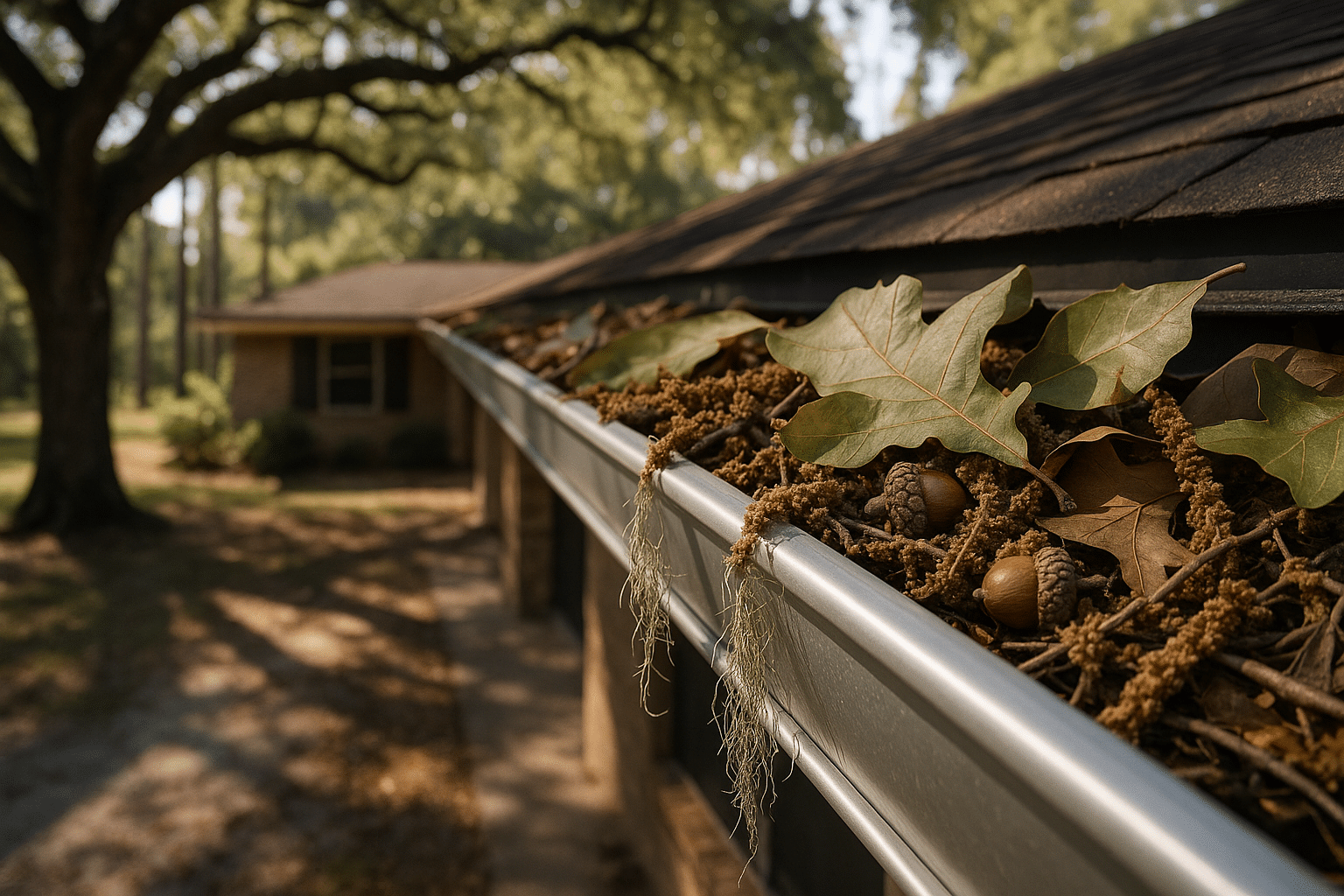
TL;DR: Central Florida’s live oaks, laurel oaks, and pines don’t shed on one tidy autumn schedule — they drop catkins in spring, acorns in late summer and fall, and leaves and pine needles almost year-round. This guide breaks down the local debris calendar month by month and explains how gutter guards and scheduled cleanings from Larry’s Gutters keep runs clear through every wave.
If you own a home under live oaks, laurel oaks, or longleaf and slash pines anywhere between Leesburg and Gainesville, you already know gutters here don’t follow the one-clog-in-autumn pattern homeowners up north deal with. Central Florida’s oak canopy produces a rolling calendar of catkins, leaves, and acorns, and our native pines shed needles practically year-round. This guide walks through what drops when, why it matters for your gutters, and how to stay ahead of it.
Why Central Florida’s Debris Season Doesn’t Follow the Rules
Most national gutter advice assumes a single fall leaf-drop season. That’s not how live oaks behave.
Although live oaks retain their leaves nearly year-round, they are not true evergreens, and they drop their leaves immediately before new leaves emerge in the spring.
That means our heaviest broadleaf litter often hits in March and April, not November.
Laurel oaks follow a similar semi-evergreen pattern. In Florida, laurel oak is semi-evergreen, dropping leaves around the same time it produces new growth, and its flowering season runs
February and March
. Add in longleaf and slash pines, which shed needles on a continuous cycle rather than all at once, and Central Florida properties face debris pressure in nearly every month of the year.
The Season-by-Season Gutter Debris Calendar
Late Winter (January–February): The Quiet Build-Up
This is the calm before the storm for oak-heavy yards. Live oaks are in a lighter drop period, but pines never fully stop. Needle cast is a normal, ongoing process, and
pine trees and other evergreen cone-bearing species experience a seasonal needle drop that is a normal part of the plant’s life cycle, since conifer needles have varying life spans and do not remain attached indefinitely.
Use this window for a pre-spring inspection, especially on homes near Astor or Astatula where mature oak and pine canopies overlap.
Spring (March–May): Peak Catkin and Leaf Season
This is the worst stretch of the year for oak-canopy properties. For live oaks,
March–April brings peak leaf drop and catkin release, making it the worst service month for oak-heavy yards.
Catkins themselves are short-lived but intense — the male flowers typically appear and fall within a few weeks, with most sources putting the window at
late March through May
.
Catkins are small and lightweight, but in volume they pack into gutter corners and downspout openings, forming a dense mat once wet. Combined with the season’s heaviest leaf drop, this is when unprotected gutters clog fastest — often within days of a cleaning.
Early Summer (May–July): Acorn Drop in Mast Years
Oaks don’t produce heavy acorn crops every year, but when they do, it adds another debris wave on top of the spring mess. In acorn years, live oaks add an
acorn drop during May–June, since oaks produce heavily every 2–4 years
. Acorns are heavier than leaves or catkins and can physically block downspout openings rather than just clog the gutter trough.
Hurricane Season (June–November): Wind-Driven Debris and Storm Surges
This is also when Florida’s afternoon thunderstorms and tropical systems put the most water through your gutters at once — exactly when a clog does the most damage. Industry guidance recommends clearing gutters and roof valleys before storms arrive, since
a gutter already clogged with spring debris backs up the moment hurricane rain starts instead of days into the cleanup.
For official storm-prep timing and safety guidance, NOAA’s hurricane preparedness resources are a good reference point before each season starts.
Summer also brings a secondary leaf drop driven by heat and drought stress. Live oaks see
summer leaf drop during drought stress in July–August
, adding more material to gutters already stressed by downpours.
Fall (September–November): The Big Acorn and Leaf Wave
This is prime acorn season for Central Florida’s laurel oaks. Laurel oak acorns
require 2 years to mature and fall to the ground during late September and October
, and squirrels help scatter them further by
aiding dissemination along with gravity and runoff during rains
. Live oaks also continue a
gradual leaf drop from September through December, punctuated by storm events
.
Late Fall into Winter: Pine Needle Cast
While oaks wind down, pines pick up. Needle cast for longleaf and slash pines
commonly occurs with needles persisting for about one and a half to two and a half years in Florida before they turn yellow, then brown, and release
, with the heaviest shedding typically in fall. Because needles are narrow and flexible, they slip through standard leaf guards far more easily than broadleaf debris — which is why pine-heavy properties need a different gutter guard strategy than oak-heavy ones.
Why This Matters More in Central Florida
Three local factors make year-round debris more damaging here than in other regions:
- Sandy soil and fast erosion: Overflow from clogged gutters concentrates water at the foundation, and our region’s sandy soils erode quickly under concentrated runoff.
- High water tables: Many lakefront and rural properties in Lake, Marion, and Sumter Counties already have minimal soil drainage capacity, so added gutter overflow has nowhere to go.
- Afternoon thunderstorms and hurricane season: Florida’s intense, fast-moving summer storms test a gutter system’s capacity instantly — a clog that’s harmless in light rain becomes an overflow event in a 2-inch-per-hour downpour.
Pros and Cons of Different Approaches
Relying on Manual Cleaning Alone
Pros: Lower upfront cost; flexible scheduling.
Cons: Given Central Florida’s overlapping catkin, leaf, acorn, and needle seasons, manual-only cleaning usually means multiple service visits per year to stay ahead of clogs — and a missed visit right before a summer storm can mean overflow damage.
Installing Gutter Guards
Pros: Dramatically reduces how often gutters need to be cleared by hand; protects against the specific debris type common to your tree canopy.
Cons: No guard eliminates cleaning entirely — fine debris like catkin fragments and pine pollen can still require occasional rinsing, and guards must be matched to your tree type to work well.
This is why Larry’s Gutters installs two different guard systems rather than one universal product. Hydro-Flo micro-mesh is built for the fine, dense debris of live oak, laurel oak, and Spanish moss common around Gainesville and Alachua neighborhoods, while Bulldog reverse-curve guards are designed for the needle loads from longleaf, slash, and sand pine common on rural and large-acreage properties near Astor and Astatula. For a deeper breakdown of which system fits your yard, see our guide to the best gutter guards for live oak, laurel oak, and Spanish moss in Central Florida.
When to Call for Professional Cleaning
Even with guards installed, seasonal and post-storm maintenance keeps a gutter system performing at its best. Consider scheduling a professional cleaning or inspection:
- Before hurricane season begins, to clear spring catkin and leaf buildup ahead of peak storm activity
- After any major named storm or sustained high-wind event
- In early fall, ahead of the heaviest acorn drop from laurel oaks
- Any time you notice water overshooting a roof valley or pooling near the foundation
Larry’s Gutters handles seasonal cleaning, realignment, and emergency storm clean-outs throughout Alachua, Lake, Marion, and Sumter Counties. If you’re in the Alachua, Micanopy, or High Springs areas, our local pages outline exactly what a cleaning visit includes: gutter cleaning and repair in Alachua, FL, gutter cleaning and repair in Micanopy, FL, and gutter cleaning and repair in High Springs, FL.
The Bottom Line
Central Florida’s oak and pine canopy means there’s rarely a true off-season for gutter debris. Catkins and leaves hit hardest in spring, acorns follow in late summer through fall, and pine needles contribute year-round. Matching your gutter system — seamless 6-inch K-style gutters, properly spaced downspouts, valley shields, and the right guard for your tree canopy — to this local debris calendar is the most reliable way to prevent overflow, fascia rot, and foundation erosion before the next storm rolls through.
Larry’s Gutters offers free, no-obligation estimates from our Leesburg and Gainesville offices, backed by a Lifetime Workmanship Guarantee. Visit our gutter services page for Leesburg and Central Florida to schedule an inspection before the next debris wave hits.
Recommended Reads
- The Best Gutter Guards for Live Oak, Laurel Oak, and Spanish Moss in Central Florida
- Gutter Services in Leesburg & Central Florida
- Gutter Cleaning and Repair in Alachua, FL | Larry's Gutters
