
TL;DR:
- Transporting gutters requires choosing the right vehicle, securing the load properly, and handling the material carefully to avoid damage. Using a pickup truck, flatbed trailer, or long wheelbase van with proper tie-downs and safety equipment ensures safe delivery to your home. Proper preparation and cautious driving help prevent accidents, bending, scratches, or road hazards during transport.
Transporting new gutters safely means choosing the right vehicle, securing the load with ratchet straps, and handling the material carefully to prevent bending, scratching, or road hazards. Gutter sections range from 10 to 50 feet in length, which makes them one of the trickier DIY loads to move. Get this step wrong and you risk warped gutters, a failed installation, or a dangerous situation for other drivers. This guide covers everything you need to know about moving new gutters from the store to your home, the right way.
How to transport new gutters: choosing the right vehicle
The vehicle you choose sets the foundation for a safe haul. Proper vehicle and mounting systems reduce the risk of unstable loads, and without them, even a short drive becomes a hazard for you and everyone around you.
Here are the most practical vehicle options for carrying gutters:
- Pickup truck: The best all-around choice. A standard 8-foot bed handles shorter sections, and you can extend the load over the tailgate for longer runs. Tie-down anchor points are built in.
- Flatbed trailer: The top pick for sections over 20 feet. A trailer gives you a flat, stable surface and plenty of anchor points. You need a vehicle with a trailer hitch rated for the load.
- Long wheelbase (LWB) or extra-long wheelbase (XLWB) van: A solid option for medium-length sections. LWB and XLWB vans can carry oversized materials when the rear doors are secured open and the load is properly flagged.
- SUV with a roof rack: Works for shorter gutter sections only. The rack must be rated for the weight and length you plan to carry. Without a rack, an SUV is not a safe choice.
- Standard sedan or compact car: Not suitable for gutter transport. The roof cannot handle the load, and there is no safe way to secure long sections.
Pro Tip: Measure your gutter sections before you pick a vehicle. Knowing the exact length tells you whether you need a trailer or whether a truck bed will do the job.
The vehicle’s tie-down system matters as much as its size. Roof racks and trailer hitches are not optional extras. They are the anchor points that keep your load from shifting at highway speed.
What equipment do you need before loading gutters?
Preparation prevents damage. Showing up at the supply yard without the right gear means you either damage the gutters during loading or make an unsafe trip home.
| Equipment | Purpose |
|---|---|
| Ratchet straps (4 minimum) | Secure the load front and rear; bungee cords are not an adequate substitute |
| Protective padding or moving blankets | Prevent scratches and dents at contact points between gutters and vehicle |
| Work gloves | Protect your hands and prevent skin oils from corroding aluminum gutters |
| Red warning flags | Required by law in most states when the load extends beyond the vehicle |
| Measuring tape | Confirm gutter length against vehicle capacity before loading |
Aluminum gutters require gloves and soft padding during handling. The oils from bare hands accelerate corrosion on raw aluminum, and even minor scratches can compromise the finish. A set of moving blankets costs very little compared to replacing a scratched or dented gutter run.
Pro Tip: Pack your ratchet straps, gloves, and padding in the vehicle before you leave home. Scrambling for supplies at the supply yard wastes time and leads to shortcuts.
Check your gutter safety gear list before every haul, not just the first one. Straps wear out, padding compresses, and flags fade. Replace anything that is not in good condition.
Step-by-step guide to loading and securing gutters for transport
Loading gutters correctly takes about 15 minutes when you have the right help and equipment. Rushing this step causes most of the damage homeowners encounter during transport.
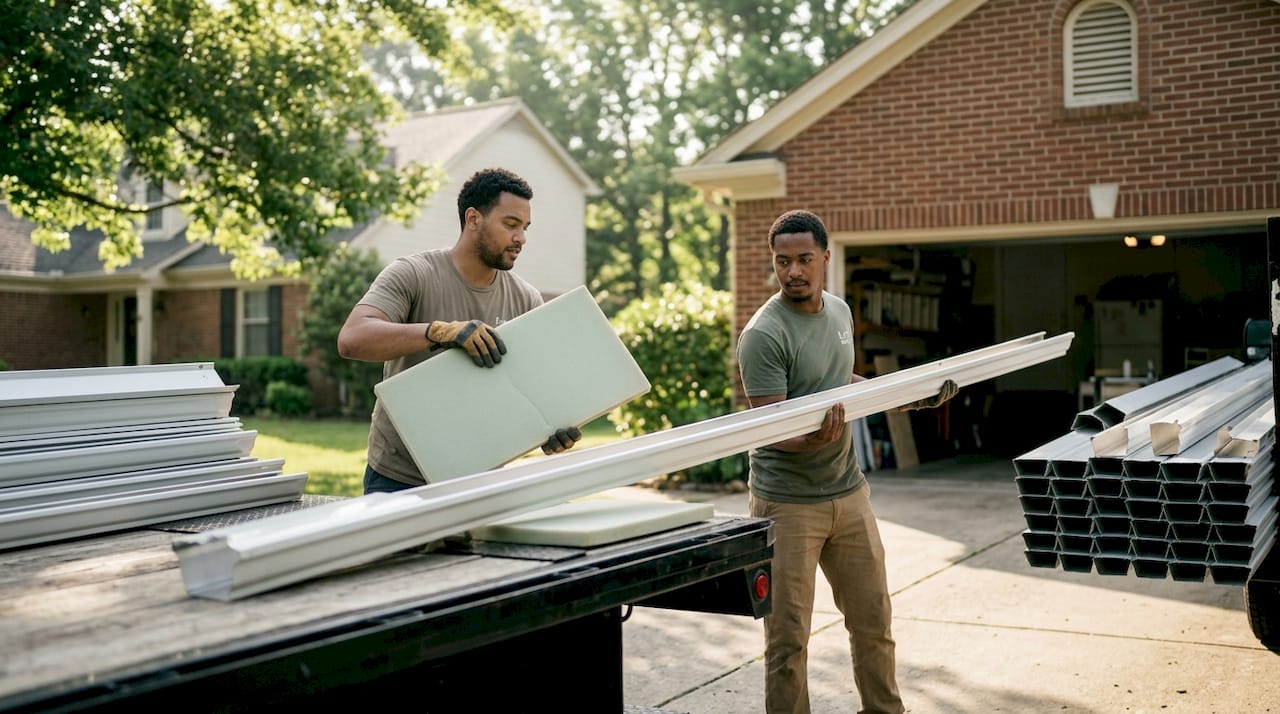
Step 1: Get a second person
At least two people are required for safe loading and unloading. Long gutter sections flex under their own weight. One person cannot control both ends, and a section that bends mid-span during loading can warp permanently.
Step 2: Position the vehicle
Back the truck or trailer as close to the gutter stack as possible. Shorter carry distance means less flex and less risk of dropping a section. If you are using a van, open the rear doors fully and confirm the interior length before you start.
Step 3: Lay gutters flat or on edge
Transport gutters flat or on edge at all times. Never stand them upright in a way that concentrates weight on a single point, and never stack heavy tools or materials on top of them. Weight on top causes permanent deformation that affects how the gutter fits against your fascia.
Step 4: Place padding at every contact point
Lay moving blankets or foam padding anywhere the gutter touches the vehicle, the rack, or another gutter section. Pay special attention to the edges of the truck bed, trailer rails, and roof rack crossbars. Metal-on-metal contact leaves marks that rust over time.
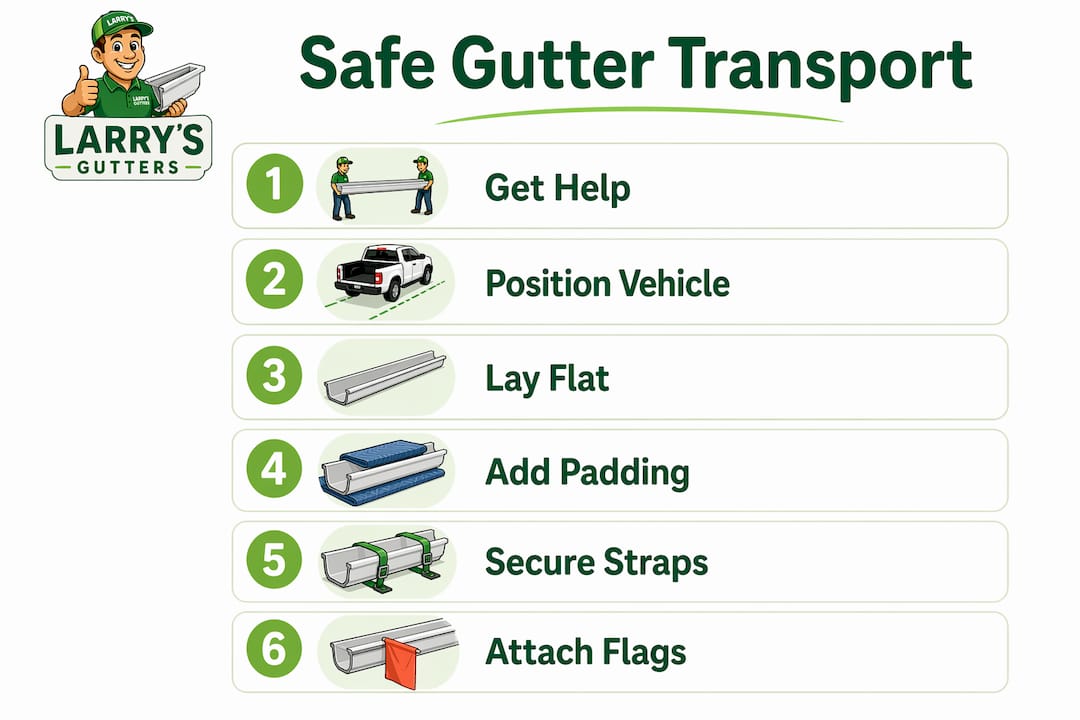
Step 5: Apply ratchet straps front and rear
Use a minimum of two ratchet straps, and four is the better standard. Place one set near the front of the load and one set near the rear. Tighten each strap until the load does not shift when you push it sideways. Bungee cords are not acceptable for this job. They stretch under load and allow dangerous movement at speed.
Safety rule: After tightening all straps, walk around the vehicle and push the load from every angle. If anything moves, tighten further or add another strap before you drive.
Step 6: Attach red flags if the load overhangs
Overhanging loads legally require red warning flags in most U.S. states. Tie a bright red flag to the rearmost point of the load. This alerts drivers behind you and keeps you on the right side of the law. Check your state’s specific overhang rules before you leave, since the permitted overhang distance varies by jurisdiction.
For more on safe handling once the gutters are on-site, the gutter installation step guide from Larrysgutters covers the full process from delivery to finished installation.
How do you drive safely when carrying a long gutter load?
Driving with a long, rigid load changes how your vehicle handles. Most homeowners underestimate this until they are already on the road.
Stopping distances increase significantly when you carry a heavy, extended load. The extra weight shifts your vehicle’s center of gravity and reduces braking efficiency. Give yourself at least twice the following distance you would normally keep.
Key driving rules for gutter transport:
- Reduce speed. For long sections, recommended speeds are 50 mph on single carriageways and 60 mph on dual carriageways. Treat these as upper limits, not targets.
- Plan your route in advance. Avoid low bridges, tight turns, and roads with overhead obstacles. Always check clearance for long loads under bridges and overhead signs before you commit to a route.
- Take turns wide and slow. Long loads swing outward on turns. A section that clears the cab can still clip a curb, a parked car, or a pedestrian at the rear.
- Pull over and recheck straps. Stop after the first mile and check every strap. Vibration from the road loosens connections that felt tight in the parking lot.
- Avoid highway driving in high winds. A long, flat gutter section acts like a sail. Strong crosswinds create lateral force that can shift even a well-secured load.
Altered vehicle dynamics with gutter loads require cautious driving, especially on unfamiliar routes. If you have never driven with an extended load before, practice in a quiet area before joining traffic.
Review the gutter safety best practices guide from Larrysgutters for a broader look at safe handling from transport through installation.
Key Takeaways
Safe gutter transport requires the right vehicle, four ratchet straps, protective padding, a second person for loading, and red flags on any overhanging load before you drive.
| Point | Details |
|---|---|
| Vehicle selection | Use a pickup truck, flatbed trailer, or LWB van with proper tie-down anchor points. |
| Strap requirement | Use four ratchet straps minimum, placed front and rear. Bungee cords are not safe. |
| Load positioning | Transport gutters flat or on edge. Never stack heavy items on top of them. |
| Protective handling | Wear gloves and use padding at all contact points to prevent corrosion and scratches. |
| Legal compliance | Attach red warning flags to any load that extends beyond the vehicle’s rear. |
What I have learned from watching homeowners haul gutters
Most DIY transport mistakes happen before the vehicle moves. The homeowner shows up with one bungee cord, no gloves, and no helper, and then wonders why the gutters arrive scratched and slightly bent. The fix is not complicated. It is just preparation.
The mistake I see most often is underestimating how much a long gutter section flexes. A 20-foot aluminum run feels stiff when it is lying flat on a stack. The moment one person tries to carry it alone, it bows in the middle. That bow can become a permanent set if the section is loaded under tension. Two people, every time, is not a suggestion. It is the only way to do it without risking the material.
Weather is the other factor most homeowners ignore. A dry, calm day makes gutter transport straightforward. Rain makes aluminum slippery and reduces your grip on straps. Wind turns a long section into a lever arm. If the forecast looks rough, delay the haul. The gutters will wait. A damaged section or a road incident will not.
The gutter care dos and don’ts resource from Larrysgutters is worth reading before your first haul. The same principles that protect installed gutters apply during transport.
— Larrysgutters
Larrysgutters can handle the heavy lifting for you
Transporting gutters yourself is absolutely doable when you follow the right steps. But if you do not have a suitable vehicle, a second person, or the time to source straps and padding, there is a simpler path.

Larry’s Gutters supplies and installs seamless gutters across Central Florida, handling every step from measurement to finished installation. You skip the vehicle rental, the strap shopping, and the two-person loading challenge entirely. For homeowners who want to know whether the product is worth the investment before committing, the Larrysgutters guide on seamless gutter value breaks down the cost and long-term benefits clearly. Request a free quote and let the team bring the gutters to you, already cut to fit.
FAQ
How many people does it take to load gutters safely?
At least two people are required to load and unload gutter sections safely. Long sections flex under their own weight and cannot be controlled safely by one person.
Can I use bungee cords to secure gutters on my truck?
Bungee cords are not adequate for securing gutters. Use a minimum of two ratchet straps, and four is the recommended standard, placed at the front and rear of the load.
Do I need a red flag on my gutter load?
Yes. Loads that extend beyond the vehicle legally require a red warning flag in most U.S. states. Attach it to the rearmost point of the overhanging section before you drive.
What is the best way to prevent scratches during transport?
Place soft padding or moving blankets at every point where the gutter contacts the vehicle or rack. Aluminum gutters also require gloves during handling to prevent skin oils from causing corrosion.
How fast should I drive with gutters on my vehicle?
Keep your speed well below normal highway limits. For long gutter sections, 50 mph on single carriageways and 60 mph on dual carriageways are the recommended upper limits to maintain load stability and safe stopping distances.
