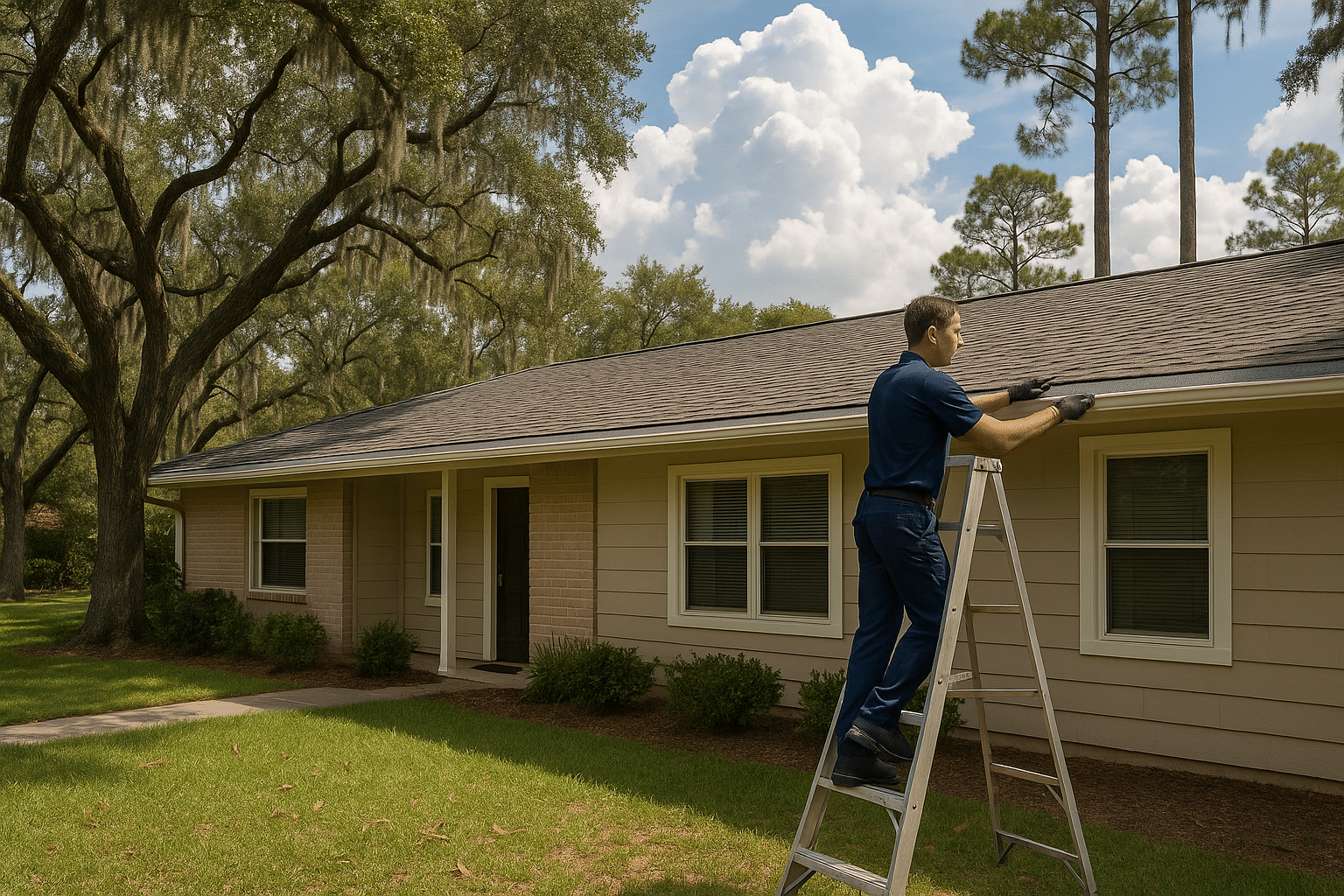
TL;DR: Central Florida’s long rainy season, intense afternoon thunderstorms, and heavy oak and pine canopy mean gutters need more attention than a simple spring-and-fall cleaning. This schedule breaks the year into four checkpoints tied to local weather patterns so homeowners in Leesburg, Gainesville, Archer, Astatula, and Astor can stay ahead of clogs, overflow, and storm damage.
If you own a home in Leesburg, Gainesville, Archer, Astatula, or Astor, your gutters work harder than gutters almost anywhere else in the country. Florida experiences more thunderstorms annually than any other state, and the state’s wet season brings heavy, fast-moving downpours that can overwhelm a clogged or poorly sized system in minutes.
Add in sandy soil that erodes quickly when water overshoots a gutter, a high water table that leaves little room for error around foundations, and a tree canopy of live oak, laurel oak, Spanish moss, longleaf pine, and slash pine, and you have a climate that demands a real maintenance schedule, not a once-a-year glance from the driveway. Here is the schedule we recommend to homeowners across Alachua, Lake, Marion, and Sumter Counties.
1. Late Winter (January-February): Pre-Season Inspection and Repair
Before the rainy season ramps up, walk your property and look for sagging sections, pulled fasteners, and gutters that no longer slope correctly toward downspouts. Winter is also when live oaks and laurel oaks drop old leaves and Spanish moss continues to shed, so debris can build up even in Florida’s cooler months.
This is the best time to schedule repairs, because contractors are less booked than in spring and early summer. If a section is leaking at a seam or pulling away from the fascia, our gutter cleaning and repair service handles realignment and seam repair before the heavy rains start.
2. Early Spring (March-April): Full Cleaning Before the Rainy Season Begins
The rainy season runs from May 15 to October 15 for Southwest Florida and from May 25 to October 10 for the rest of West Central Florida
, according to the National Weather Service. That gives homeowners a narrow window in March and April to get every gutter fully cleaned out before the daily downpours arrive.
Clear leaves, pine needles, and moss from the gutter channel, flush downspouts with a hose, and confirm water exits well away from the foundation. On sandy Central Florida lots, overshooting water at this stage can carve a trench in a single bad storm.
3. Early Summer (May-June): Check Before the Wet Season Peaks
Once the rainy season begins,
late May through June is the period when severe storms are most likely, with hail, damaging winds, and waterspouts common in addition to heavy rainfall and frequent lightning
. This is also when
hurricane season officially begins on June 1 and runs through November 30
.
Do a quick visual check after the first few big storms. Look for water pouring over the gutter edge instead of into it — a sign of a clog, undersized gutter, or too few downspouts. Our standard installs use 6-inch K-style gutters with downspouts roughly every 40 linear feet, sized specifically for Florida’s heavy summer downpours, but even a correctly sized system needs debris cleared to perform.
4. Mid-to-Late Summer (July-August): Mid-Season Clean-Out
July through early September is when the rainy season peaks, and while the overall threat for severe weather diminishes, heavy rainfall and seasonal river flooding remain significant hazards
. Lakefront properties around Astatula and Astor see this most directly, since saturated ground and high water tables leave less buffer before standing water becomes a problem.
A mid-summer clean-out catches the seed pods, oak debris, and pine straw that accumulate between spring and fall before they compact into a dense mat. This is also a smart time to double-check valley shields are still seated properly, since they’re doing extra work diverting water at roof valleys during peak storm months.
5. Pre-Hurricane Season Prep and Storm Watch (Peak Months)
The peak of the Atlantic hurricane season typically runs from mid-August to mid-October
. Whatever tropical activity the season brings, clear gutters and secure downspouts make a measurable difference in how well a home sheds wind-driven rain.
Before any storm with a forecast track near Central Florida, confirm downspouts are clear and extensions are pointed away from the foundation. After the storm passes, inspect for loose sections, debris pile-up, or detached downspouts before the next system arrives. If you need help fast, our emergency clean-out service is built for exactly this window.
6. Fall (October-November): Post-Wet-Season Cleaning and Inspection
As the rainy season winds down, schedule a full cleaning to remove everything that accumulated over summer and clear out any leftover hurricane-season debris. This is also the right time for a thorough inspection: check fascia boards for soft spots, hangers for rust or looseness, and seams (if you have older sectional gutters) for leaks.
If you’re tired of climbing a ladder four times a year, this is also a natural point to evaluate gutter guards. Homes shaded by live oak, laurel oak, and Spanish moss are good candidates for our Hydro-Flo micro-mesh system, while homes surrounded by longleaf, slash, or sand pine do better with Bulldog reverse-curve guards built for heavy needle loads. We cover the tree-specific differences in detail in our gutter guard comparison for Central Florida’s tree canopy.
7. Early Winter (December): Year-End Check and Planning Ahead
Close out the year with a quick visual inspection, especially after any late-season tropical activity. This is also a good time to budget for the year ahead if you’re considering an upgrade, a repair, or a gutter guard system. If you want to understand what a project will run before committing, our seamless gutter pricing guide breaks down what affects cost for Central Florida homes.
Why Central Florida Needs a Tighter Schedule Than the National Average
Much of the generic gutter-cleaning advice circulating online recommends just two cleanings a year. That works in regions with a short fall leaf-drop and a dry rest of the year. It doesn’t hold up in Central Florida, where
thunderstorms are ubiquitous during the summer and Florida experiences the highest annual number of thunderstorms in the United States
, and where broadleaf and pine debris falls nearly year-round rather than in one autumn burst.
Florida’s climate is characterized by wet and dry seasons, with rainfall predominantly occurring between June and October, and annual rainfall amounts ranging from 40 to 60 inches per year depending on location
. That volume of water has to go somewhere, and a gutter system clogged with live oak leaves or pine needles simply can’t move it fast enough.
Who This Schedule Matters Most For
- Lakefront and waterfront owners around Astor and Astatula, where high water tables leave little margin for overflow or erosion near the foundation.
- Retirees and 55-plus community residents who may prefer not to climb a ladder four to six times a year — seasonal maintenance plans handle this for you.
- Landlords and property managers responsible for multiple units across Alachua, Lake, Marion, or Sumter Counties, where a missed cleaning can mean a tenant complaint after the next storm.
- Rural and large-acreage owners with long fascia runs and heavier pine debris loads from longleaf and slash pine.
Keep It Simple With Seasonal Maintenance
Most homeowners don’t want to track four or five dates on a calendar. Our gutter services for Leesburg and Central Florida include seasonal cleaning plans built around this exact schedule, plus realignment, repair, and storm clean-out when you need it. Every job is backed by a Lifetime Workmanship Guarantee, and estimates are always free with no obligation.
Recommended Reads
- Gutter Services in Leesburg & Central Florida
- Gutter Cleaning & Repair in Leesburg & Central Florida
- What Do Seamless Gutters Cost in Central Florida? A 2025 Pricing Guide
