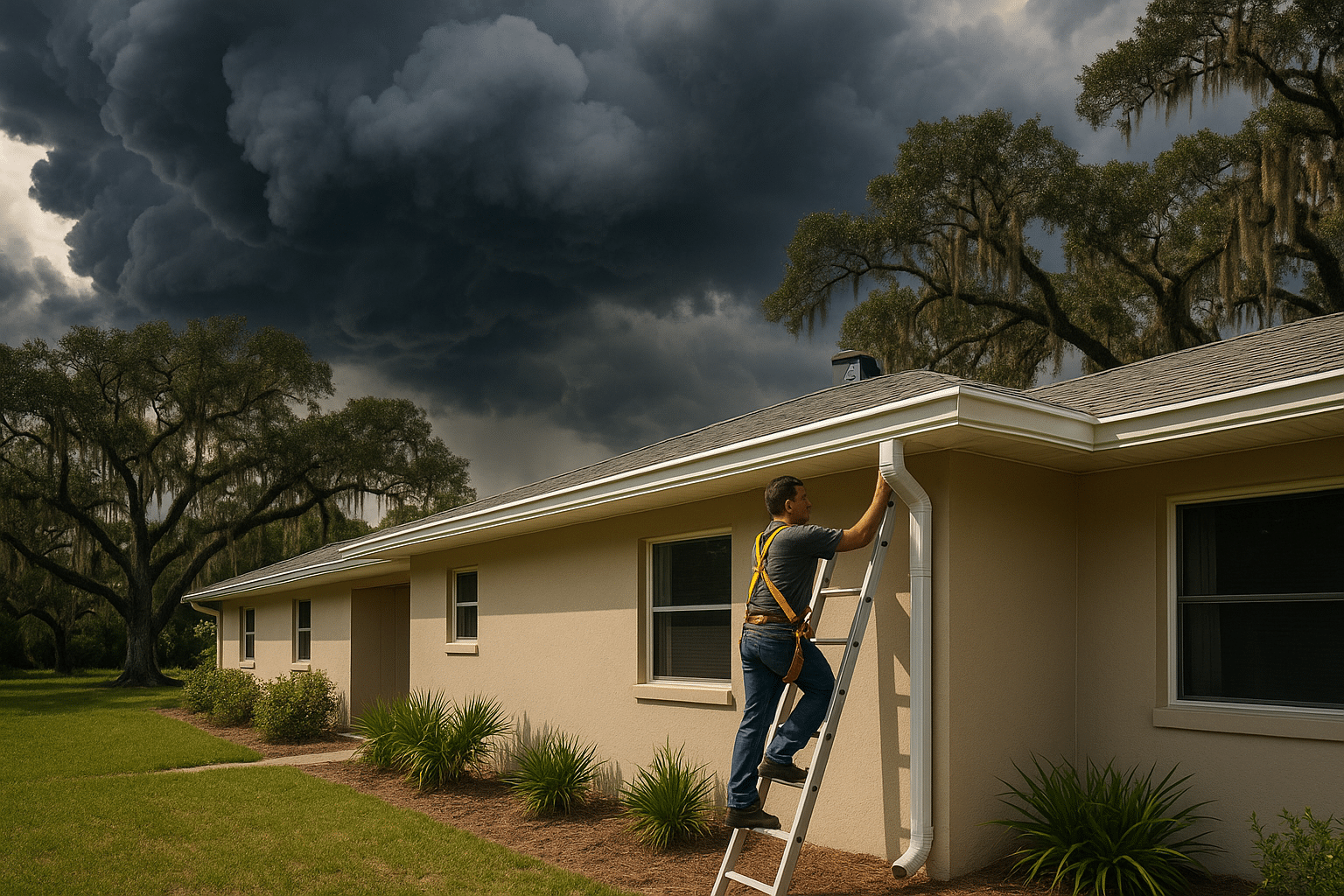
TL;DR: Central Florida’s rainy season brings near-daily afternoon thunderstorms from late May through mid-October, and gutters that were fine in April can overflow fast once that pattern sets in. This guide walks you through a practical pre-season inspection and prep routine, covering what to check, what tools you need, and the mistakes that lead to fascia rot, foundation erosion, and emergency storm calls.
If you live in Leesburg, Gainesville, Archer, Astatula, or Astor, you already know the drill: clear skies all morning, then a wall of clouds builds by early afternoon and the sky opens up. That’s Central Florida’s rainy season, and it puts more stress on a gutter system in five months than the rest of the year combined.
The National Weather Service office in Tampa Bay defines the rainy season as running from May 15 to October 15 for Southwest Florida and from May 25 to October 10 for the rest of West Central Florida, and during this stretch storms build the same way almost every day. As one regional breakdown explains, the collision of sea breezes provides significant atmospheric uplift, leading to the rapid formation of intense, localized thunderstorms that typically begin between noon and 2:00 p.m. Central Florida sees this pattern more than anywhere else in the country, which is earning the region the title of the nation’s lightning capital.
Getting your gutters ready before that pattern locks in is a lot cheaper than dealing with an overflow problem in August. Here’s how to do it.
What You’ll Need
- A sturdy ladder rated for your height, placed on firm, level ground
- Work gloves and safety glasses
- A garden hose with a spray nozzle
- A small trowel or gutter scoop for debris
- A bucket or tarp to catch what you pull out
- A flashlight for checking inside corners and seams
- A notepad or phone camera to track problem spots
If your home has a steep roof pitch, multiple stories, or you’re not comfortable on a ladder, this is a good job to hand off to a professional instead.
How to Prep Your Gutters for Rainy Season: Step by Step
-
Check the calendar and get ahead of the onset
Don’t wait for the first big storm. Rainy season timing shifts year to year, but it can begin abruptly in some years while the onset takes weeks to develop in other years, so the beginning of the rainy season is usually a transition period rather than a single date. Plan your inspection for April or early May, before afternoon storms become a daily habit.
-
Clear out winter and spring debris first
Central Florida’s live oaks, laurel oaks, and pines don’t go dormant the way northern trees do, so debris builds up year-round. Before rainy season starts, clear out accumulated leaves, oak catkins, pine needles, and any seed pods sitting in the trough. If you’re not sure what’s typically falling and when in your yard, our season-by-season guide to oak and leaf debris breaks down what to expect month by month.
-
Flush the system with a hose
Run water from the far end of each gutter run toward the downspout. Watch for slow spots, standing water, or water that backs up instead of draining. This tells you where a clog or a sag in the gutter line is hiding before a storm finds it for you.
-
Inspect every downspout outlet
Downspouts are where small clogs turn into big overflow problems. A properly planned system spaces downspouts roughly every 30 to 40 feet of gutter run so no single outlet is overwhelmed; one common guideline recommends
installing a downspout every 30 to 40 feet of gutter
. If your home has long, unbroken fascia runs with only one or two downspouts, flag it as a priority fix before the season starts. -
Confirm water is actually leaving the foundation area
Central Florida’s sandy soil drains fast in some spots and poorly in others, especially near slab edges and compacted areas close to the house. Downspout extensions and splash blocks should move water well clear of the foundation; general guidance from building professionals puts the safe range at
at least 4 to 6 feet away from the foundation, with 8 to 10 feet being the ideal distance for long-term protection
. On lakefront or low-lying lots around Lake County, err toward the longer distance. -
Check hangers, seams, and fascia for damage
Look for gutters pulling away from the fascia, sagging sections, or rust streaks on seamed gutters. Seamless K-style systems don’t have the mid-run joints that typically fail first, but hangers can still loosen from heat cycling and storm wind. Any soft or discolored fascia board behind the gutter is a sign water has already been getting behind the system.
-
Check or upgrade gutter guards for your tree canopy
If you’re under live oaks, laurel oaks, or Spanish moss, fine debris and moss fragments are the main clog risk, which is why micro-mesh systems are built for that load. If you’re surrounded by longleaf, slash, or sand pine, needle clusters are the bigger issue and call for a different guard design entirely. Matching the right guard to your actual tree canopy before storms ramp up saves you from mid-season clean-outs.
-
Walk the valleys and roof-to-gutter transitions
Roof valleys concentrate a huge volume of water into a small stretch of gutter, and without a valley shield that water can overshoot the gutter entirely during a heavy downpour. Confirm valley shields are in place and undamaged, especially after winter winds or any recent roof work.
-
Schedule a mid-season check-in
One pre-season cleaning won’t carry you through five months of near-daily storms and constant leaf and needle drop. Plan a follow-up cleaning around mid-summer, and consider a standing seasonal maintenance plan if your property has heavy tree coverage. See our gutter cleaning and repair services for what a seasonal visit typically includes.
-
Fold hurricane prep into the same checklist
Rainy season and hurricane season overlap almost entirely in Florida, so it makes sense to prep for both at once. Walk through our hurricane season gutter checklist once named storms start showing up in the forecast, since the stakes go up fast once tropical rain rates get involved.
Common Mistakes Homeowners Make
- Waiting until the first big storm to check gutters. By the time water is pouring over the front lip during a downpour, the system is already overwhelmed and you’re reacting instead of preventing.
- Assuming one downspout is enough for a long run. Builder-grade homes are sometimes installed with the bare minimum of outlets, which works fine in a light rain and fails the moment a real Central Florida storm cell parks overhead.
- Letting splash blocks do all the work on clay-heavy or compacted lots. A basic splash block only moves water a couple of feet, which isn’t enough distance if the soil near your slab doesn’t drain quickly.
- Ignoring valley areas because the straight runs look fine. Most overflow damage during Florida’s heaviest cells happens at valleys and corners, not along flat stretches of gutter.
- Skipping gutter guards because of pollen or catkin season. Oak catkins and Spanish moss are exactly the fine debris that overwhelms open gutters every spring, right before rainy season peaks.
- Treating gutter prep as a one-time spring task. With oak leaf drop, pine needle fall, and summer storms all overlapping, Central Florida gutters need more than one look a year.
Why Gutter Sizing Matters More Here Than Up North
Standard residential gutters across most of the country are sized for rainfall intensities that Florida blows past on a regular afternoon. That’s part of why 6-inch K-style gutters, not the 5-inch gutters common in drier climates, are the standard install for homes across Lake, Marion, Sumter, and Alachua Counties. If you’re budgeting for a new system or a replacement before this year’s storms ramp up, our seamless gutter cost guide breaks down what goes into pricing locally.
Every gutter system we install is fabricated on site with a portable forming machine, so each run is cut to the exact length of your fascia with no seams to leak or clog mid-run. Combined with proper downspout spacing and valley shields, that’s the foundation of a system built to handle Central Florida’s rainy season rather than just survive it.
When to Call a Professional Instead of DIY-ing It
A basic inspection and cleaning is a reasonable DIY job for a single-story home with easy roof access. Call a professional if you notice sagging sections, fascia damage, repeated overflow even after cleaning, or if your property has tall trees and awkward roof angles that make ladder work risky. A free on-site estimate can tell you quickly whether you’re dealing with a simple cleaning or a sizing and repair issue.
Recommended Reads
- Florida Hurricane Season Gutter Checklist: How to Prep Before the Storm
- Oak Catkins, Acorns, and Leaf Drop: A Season-by-Season Guide to Gutter Clogs in Central Fl
- Gutter Services in Leesburg & Central Florida
Sources
