
TL;DR:
- A gutter service contract is a written agreement that defines work scope, frequency, costs, and responsibilities, helping property owners in Central Florida prevent damage and disputes. Recurring maintenance plans offer cost predictability, early problem detection, and property protection compared to one-time services. Proper management, clear clauses, documentation, and communication ensure long-term gutter system health and maximum value.
If you’ve ever dealt with overflowing gutters, rotted fascia, or a flooded foundation during a Florida summer storm, you already know what poor gutter maintenance costs. This guide to gutter service contracts is written specifically for Central Florida homeowners and property managers who want to stop reacting and start protecting their properties with a proper maintenance plan. You’ll find everything you need to understand what these contracts cover, what they should cost, which clauses actually matter, and how to manage the relationship with your service provider so nothing falls through the cracks.
Table of Contents
- Key takeaways
- Guide to gutter service contracts: what they are and why they matter
- What to look for in a gutter service agreement
- Evaluating costs and value for Central Florida properties
- Best practices for managing gutter maintenance contracts
- Handling issues and keeping contractors accountable
- My honest take on gutter contracts in Central Florida
- Work with a team that understands Florida gutters
- FAQ
Key takeaways
| Point | Details |
|---|---|
| Contracts define clear scope | A written service agreement spells out exactly what work is included and prevents billing surprises. |
| Florida costs are predictable | Gutter cleaning for most Central Florida homes falls in a known price range you can budget around annually. |
| Insurance verification matters | Always request proof of insurance directly from the insurer, not just a certificate from the contractor. |
| Documentation protects you | Keeping records of every service visit gives you leverage if disputes or warranty claims arise. |
| Regular contracts beat one-time calls | Recurring maintenance plans catch problems early and save more money over time than emergency service calls. |
Guide to gutter service contracts: what they are and why they matter
A gutter service contract is a written agreement between a property owner and a gutter service company that defines the work to be done, how often it will happen, what it will cost, and who is responsible for what. That may sound like basic paperwork, but for Central Florida homeowners dealing with heavy seasonal rainfall and fast-growing debris from oak trees, palms, and pine needles, a formal contract is what separates a reliable maintenance relationship from a frustrating guessing game.
There are two types of service arrangements most companies offer. The first is a one-time service call, where you pay for a single visit with no ongoing commitment. The second is a recurring maintenance contract, sometimes called a gutter maintenance plan, where you pay for scheduled cleanings and inspections throughout the year. For most property owners with significant tree canopy or multi-story homes, recurring contracts win on every measure: cost predictability, property protection, and peace of mind.
What does a solid gutter service contract typically cover? Here is what you should see in a well-written agreement:
- Regular debris removal from gutters and valleys
- Flushing downspouts to check for blockages
- Visual inspection of gutter hangers, seams, and end caps
- Debris disposal (this matters more than it sounds — confirm it’s included)
- A written report of any damage or repairs needed
What it typically does NOT include: structural gutter repairs, gutter guard installation, or painting. Contracts clearly specify included and excluded services to prevent misunderstandings. If a contractor hands you an agreement without an exclusions section, ask for one in writing before you sign.
The liability side of these contracts is often ignored by homeowners, and that’s a mistake. A clear contract protects you if a worker is injured on your property, prevents automatic price increases without notice, and gives you documented recourse if the work is substandard.
What to look for in a gutter service agreement
Knowing that a contract should be detailed is one thing. Knowing exactly which clauses to read carefully is what separates a homeowner who signs confidently from one who discovers problems six months later.
Parties, scope, and exclusions
The contract should name every party involved, not just your company and theirs. Clearly defined roles covering who approves work, who receives invoices, and who signs change orders reduce the most common source of confusion in service relationships. For property managers overseeing multiple units, this matters even more.
The scope of work section is where contracts succeed or fail. Vague language like “gutter maintenance as needed” is a red flag. You want line-by-line specifics: number of service visits per year, what each visit includes, and a defined mechanism for requesting extra work outside that scope.
Pricing, renewals, and dispute resolution
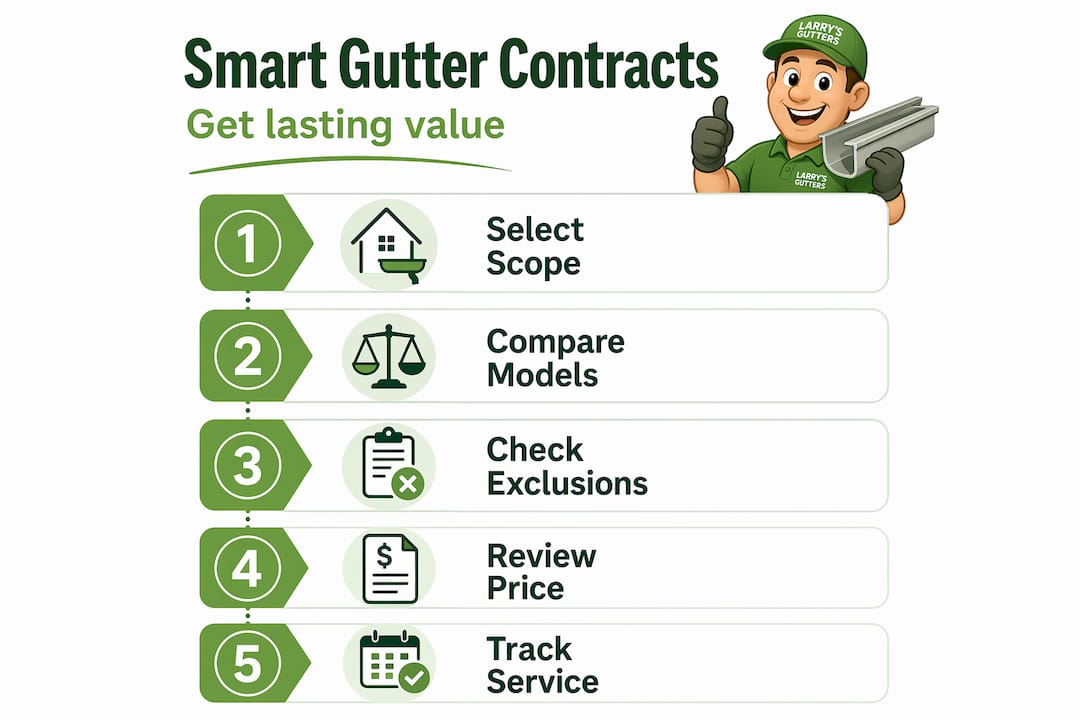
Here is a checklist of contract clauses worth reviewing before you sign:
- Pricing structure. Is it a flat annual fee, a per-visit charge, or a tiered model based on home size? Make sure you understand what triggers additional charges.
- Renewal terms. Does the contract auto-renew? By how much can the price increase at renewal without your written consent?
- Insurance requirements. The contractor must carry both general liability and workers’ compensation. Request certificates directly from the insurer to avoid the risk of a policy that was canceled after the certificate was printed.
- Change orders. Any work outside the original scope should require written approval with a new price before the work starts.
- Dispute resolution. Look for a tiered escalation process: direct negotiation first, then mediation, then arbitration. Contracts with tiered escalation clauses keep disputes from turning into legal bills.
- Termination clause. You should be able to exit with 30 days written notice if performance doesn’t meet stated standards.
Pro Tip: Ask for a scope boundary worksheet as an appendix to the contract. This single-page document lists what is and is not included so both parties can make fast, clear decisions when questions come up mid-service.
Evaluating costs and value for Central Florida properties
Central Florida homeowners are often surprised by how much pricing varies for what looks like the same service. Understanding what drives those differences helps you evaluate contracts fairly rather than just picking the lowest number.

Gutter cleaning costs in 2026 range from $175 to $425 for typical homes, with higher costs for complex properties or those requiring gutter guard removal. In the Orlando and surrounding Central Florida market, single-story homes on the smaller side sit toward the lower end of that range. Two-story homes with long gutter runs or heavy oak canopy coverage push toward the top.
The table below compares the two most common contract pricing structures:
| Pricing model | Best for | Typical cost range | Watch out for |
|---|---|---|---|
| Fixed annual contract | Homeowners wanting predictability | $350 to $800/year for 2 visits | Auto-renewal clauses with no price cap |
| Per-visit pricing | Seasonal or occasional needs | $175 to $425 per visit | No service guarantee between visits |
| Subscription/retainer | Property managers with multiple units | Negotiated bulk rate | Vague scope leading to scope creep |
The subscription or retainer model deserves more attention than it gets. When retainer agreements clearly define what is included, what is not, and how extra work gets billed, they work extremely well for property managers. The risk is a poorly written retainer with no scope limits, which invites exactly the kind of billing disputes and “while you’re at it” requests that erode the value of the arrangement.
Look at the total cost of the contract compared to what a single emergency repair would run. Preventive maintenance contracts save homeowners money by avoiding emergency repairs and extending gutter system life. One call to fix water damage to fascia or foundation grading can easily exceed the entire annual cost of a maintenance contract.
Best practices for managing gutter maintenance contracts
Signing a good contract is step one. Managing it well is what actually protects your property over the long term.
Start with communication. Before the first service visit, confirm with the provider who your point of contact is, what the response time expectation is for non-emergency questions, and how you will receive service reports. This sounds obvious, but many disputes come from nothing more than a breakdown in basic communication.
Here are the practical habits that make gutter service relationships work:
- Document every visit. Keep a simple log: date of service, what was done, what issues were noted, and who performed the work. Photos from the service report are even better.
- Schedule cleanings before peak seasons. In Central Florida, that means before summer storms and after fall leaf drop. Don’t wait for the gutters to overflow before calling.
- Verify insurance annually. Contractor policies renew yearly. Add a calendar reminder to request updated certificates each year, directly from the insurer.
- Put change requests in writing. If you want extra work done during a scheduled visit, send an email before the appointment. This creates a paper trail and prevents verbal misunderstandings about cost.
- Review the contract at renewal. Prices, scope, and your property’s needs can all change. A renewal is the right time to renegotiate terms, not after you’ve already signed.
Pro Tip: Cross-reference your gutter service schedule with your home maintenance checklist to make sure service visits align with Florida’s rainfall patterns and not just calendar quarters.
Avoiding common pitfalls is equally important. Vague scope language is the number one cause of contract disputes. Underpriced contracts are the second: a contractor who bids too low will either cut corners or look for ways to charge for extras. Both outcomes hurt you.
If you are managing multiple properties, treating contracts as a coordinated part of home improvement planning helps you schedule and budget service visits without conflicts.
Handling issues and keeping contractors accountable
Even with a well-written contract and a reliable provider, problems come up. Knowing how to handle them efficiently is what keeps a service relationship intact.
Watch for these signs that your gutter service is falling short:
- Visible debris after a service visit. If gutters are clogged within days of a cleaning, either the job was incomplete or your scheduling needs adjustment.
- Downspouts still blocked. Flushing downspouts should be standard. If water isn’t flowing through them after service, flag it immediately.
- No written report. Any reputable contractor should provide a brief note on what was done and what needs attention.
- Delayed responses. If it takes more than 48 hours to get a reply to a service question, check your contract’s response-time clause and enforce it.
When something goes wrong, follow your contract’s escalation steps in order. Start with a written email to your direct contact. If that doesn’t resolve it, reference the dispute resolution clause and move to the next tier. Structured tiered escalation prevents disputes from turning into indefinite delays or expensive legal fights.
Warranties matter here too. If your contract includes a service warranty, document the failure with photos and timestamps before doing any additional work. That documentation is your foundation for a warranty claim. Well-defined performance standards in the original contract make these claims far easier to resolve without conflict.
My honest take on gutter contracts in Central Florida
I’ve reviewed a lot of service agreements in this industry, and the pattern is consistent: the contracts that cause the most grief are not the ones with complicated clauses. They’re the ones that are too vague to mean anything.
In my experience, the most valuable thing a homeowner or property manager can do before signing any gutter service agreement is to spend ten minutes reading the scope of work section out loud. If it sounds like it could mean two different things, it will. Contractors aren’t always trying to be deceptive. More often, vague language is just a template that nobody updated. But vague language always benefits the party that performs the work, not the one paying for it.
I’ve also seen what happens when property managers treat contracts as adversarial. They push for the lowest price, the contractor finds ways to protect their margin, and the service quality drops. The better approach is collaborative. Go into negotiations with a clear list of what you need, ask the contractor what makes their job easier, and build those answers into the contract. That kind of arrangement produces better service, fewer disputes, and a provider who actually wants to keep your account.
The role of routine gutter maintenance in protecting a home’s structural integrity is not overstated. A contract is not just an administrative document. It’s the mechanism by which that protection becomes consistent and predictable.
— Larrysgutters
Work with a team that understands Florida gutters
If you’re ready to move from reactive maintenance to a real plan, Larrysgutters is built for exactly that.

Larry’s Gutters specializes in seamless gutter installation, gutter guard installation, and maintenance services across Central Florida’s most demanding climates. Whether you want to understand if seamless gutters are worth the investment for your property or you’re ready to discuss a customized maintenance contract, the team offers free quotes with transparent, line-by-line pricing. No vague scope. No hidden fees. If you manage multiple properties or just want the confidence of knowing your home is protected before the next storm season, contact Larrysgutters directly to discuss a maintenance plan that fits your property and your budget.
FAQ
What does a gutter service contract typically include?
Most gutter service contracts cover debris removal, downspout flushing, visual inspection, and debris disposal. Standard contracts specify inclusions and exclusions clearly to prevent misunderstandings after service visits.
How much does a gutter maintenance contract cost in Central Florida?
Recurring maintenance contracts for Central Florida homes generally run $350 to $800 per year for two scheduled visits, based on 2026 cleaning cost data ranging from $175 to $425 per visit. Home size, gutter complexity, and additional services like gutter guard removal affect the final price.
How do I verify a gutter contractor’s insurance?
Request insurance certificates directly from the contractor’s insurer, not just from the contractor. Certificates from insurers confirm the policy is active and hasn’t been canceled since the document was issued.
What should I do if my gutter service isn’t meeting contract standards?
Start by sending a written complaint to your contractor and referencing the specific clause they’ve failed to meet. If that doesn’t resolve the issue, follow the contract’s tiered dispute resolution process, moving from negotiation to mediation before considering arbitration.
Are recurring gutter contracts better than one-time service calls?
For most Central Florida homeowners, yes. Set-and-forget maintenance programs prevent the costly emergency repairs that stem from neglected gutters, including fascia rot and foundation erosion, at a lower total annual cost than multiple one-time calls.
