
Roof runoff management means controlling where rainwater goes after it hits your roof, before it hits your foundation, your neighbor’s yard, or the nearest storm drain. The core principle, as Virginia Cooperative Extension puts it, is simple: slow it down, spread it out, and soak it in. The main tools for doing that are:
- Gutters and downspouts to collect and channel water off the roof
- Extension pipes and splash blocks to move water away from the foundation
- Rain barrels to capture and store water for later use
- Rain gardens and dry wells to infiltrate water back into the ground
- Vegetated swales to slow and filter runoff across the landscape
One rule applies to every method: never direct runoff onto a neighbor’s property. Washington State University extension experts are direct on this point, advising homeowners to outlet water well away from property boundaries, since doing so only transfers your drainage problem to someone else.
Common roof runoff management methods every homeowner should know
Rooftop redirection is the least expensive place to start, typically costing $25 to $100 per downspout. It works by attaching flexible fittings and extension pipes to existing downspouts and pointing the flow toward a lawn, flowerbed, or vegetable garden instead of a driveway or curb.
Getting the gutter slope right matters more than most homeowners realize. A standard 4-inch wide gutter needs roughly a 1/8-inch drop per 10 feet of length to keep water moving, and one 2×2-inch downspout handles about 2,000 square feet of roof area. Undersized downspouts are one of the most common reasons gutters overflow during heavy rain.
Beyond basic gutters, several devices handle water that the primary system cannot absorb fast enough:
- Rain barrels collect overflow at the downspout for use on gardens during dry spells; typical cost runs around $100
- Dry wells store water underground and release it slowly into surrounding soil, costing roughly $500 installed
- Rain gardens are shallow planted depressions that hold runoff until it evaporates or infiltrates, and they also support pollinators
- Grass swales move water slowly across a vegetated channel, filtering sediment along the way
The receiving area for any disconnected downspout should be at least 10% of the drained roof area and sit at least 10 feet from the next impervious surface. That spacing gives the soil enough room to absorb the flow before it reconnects with pavement.
Pro Tip: If your lawn compacts easily, aerate it every three years. Compacted soil rejects water instead of absorbing it, turning your carefully redirected downspout into a surface flood.
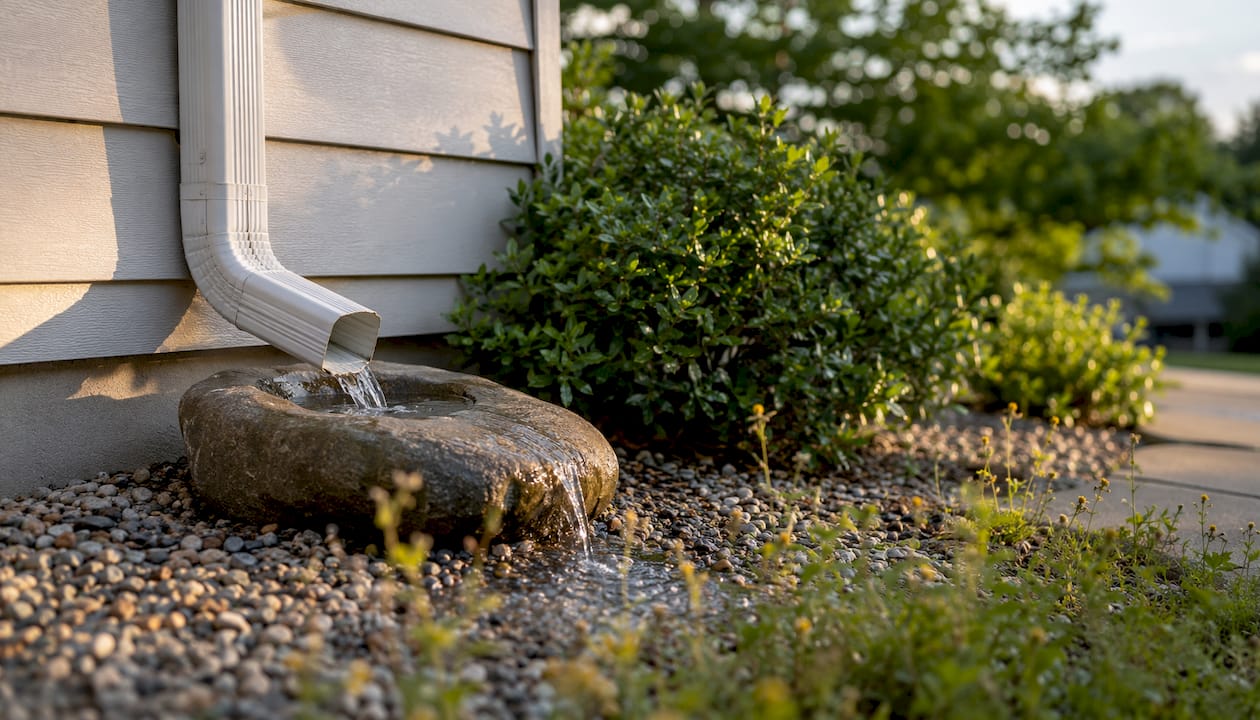
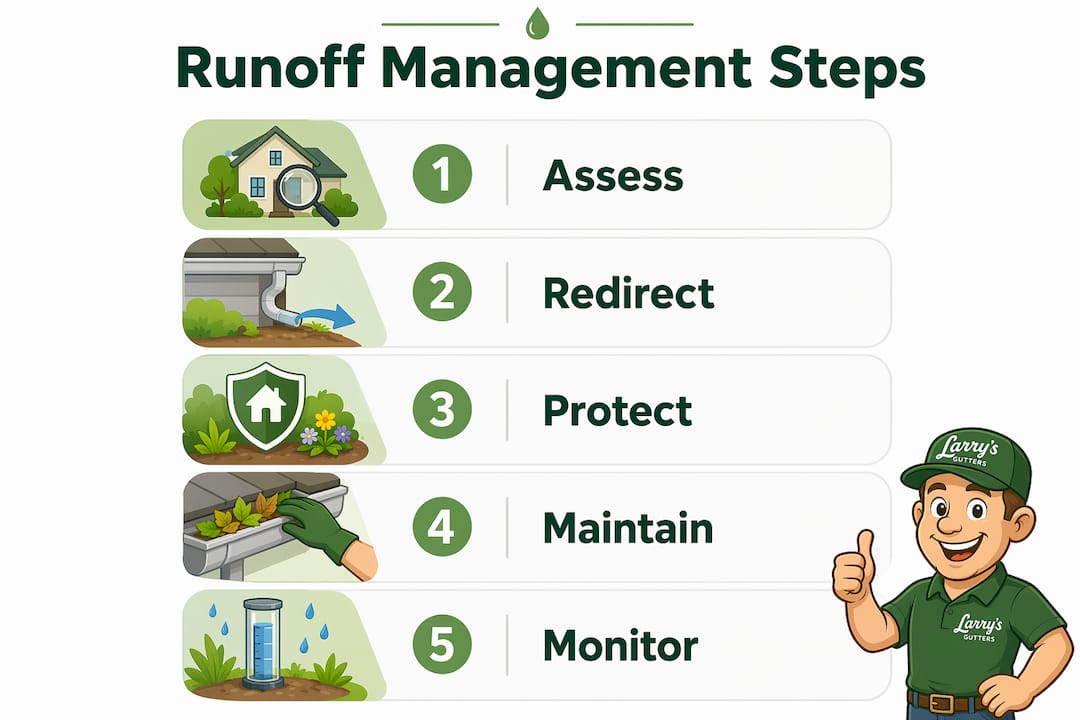
Gutters need to be cleaned at least twice a year, more often if trees overhang the roofline. Check all elbows and bends for clogs, inspect for sagging sections, and replace hangers before a small sag becomes a full overflow point. A quick post-storm walkthrough catches most problems before they become expensive ones. For a full seasonal checklist, Larrysgutters has a Florida maintenance guide worth bookmarking.
How to manage runoff when you don’t have gutters
No gutters does not mean no options. Several approaches work well for structures where gutters are impractical or missing.
- Ground gutters work on buildings with eaves extending at least 12 inches horizontally; they catch drip-line water and channel it to a stable outlet, though they require the same capacity sizing as roof gutters
- French drains and buried corrugated pipe carry water underground and away from the building; a single 4-inch corrugated pipe with a slope of 0.01 feet per foot of run can handle runoff from up to 5,400 square feet of roof
- Vegetated swales dispersed along the drip line slow water and let it infiltrate gradually rather than pooling
- Extension pipes laid on the surface offer a temporary fix, directing water to a safe landing zone until a permanent solution is installed
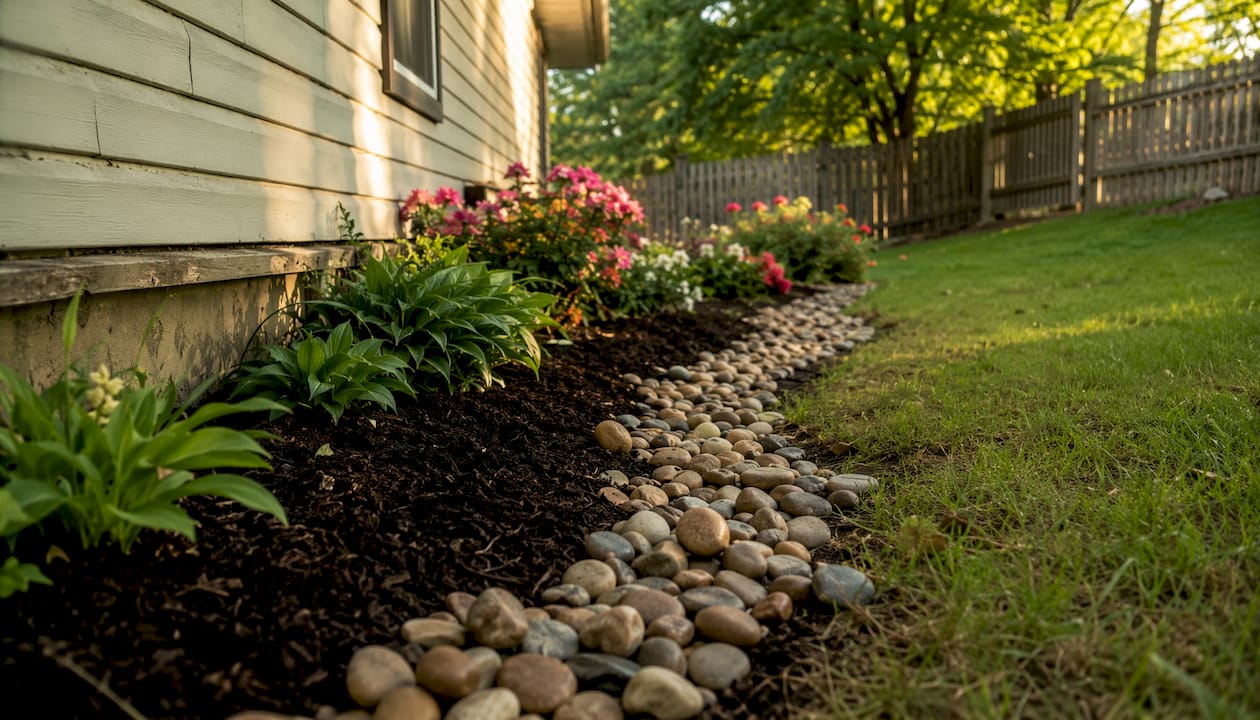
The biggest mistake on gutter-free properties is letting the drip line erode bare soil year after year. Placing medium-sized stones or a gravel apron under the eave breaks the water’s fall and prevents the soil from washing away. Pairing that with a rain garden or dry well positioned a few feet downhill gives the water somewhere to go.
Sloped yards add another layer of complexity. Runoff accelerates on grades above 5%, so any receiving area needs dense vegetation to slow the flow. If you’re also planning fencing on a sloped lot, it’s worth reading about fences for uneven ground, since fence posts and drainage channels often need to be coordinated to avoid redirecting water in unintended directions.
Best practices and common mistakes in roof drainage
The single most common error is discharging downspouts onto driveways, sidewalks, or curbs. Water running across those surfaces picks up oil, sediment, and fertilizer before reaching the storm drain. Pointing the same downspout toward a lawn costs nothing extra and keeps those pollutants out of the waterway.
A few practices separate a well-designed system from one that fails at the first heavy storm:
- Keep each downspout draining no more than 1,000 square feet of roof to avoid overwhelming the receiving area
- Position all outlets at least 6 feet from basement walls and 2 feet from any crawl space
- Never drain over septic systems, drain fields, or decommissioned underground tanks
- Use a splash block at every downspout end to prevent soil erosion at the outlet point
Pro Tip: In areas with vehicle or foot traffic near downspouts, insert the lower five feet of the downspout through a 6-inch diameter steel or PVC sleeve. It costs a few dollars and prevents years of dent-and-replace cycles.
Protecting downspouts from physical damage is an underrated part of system longevity. A crushed downspout backs water up into the gutter, which then overflows at the fascia board, exactly where you don’t want it. For guidance on roof-to-gutter water flow and how a properly installed system handles heavy Florida rain, Larrysgutters covers the mechanics in detail.
Regulations vary by location. Oklahoma, for example, currently has no rules specifically governing residential downspout disconnection, though state MS4 permits encourage it. Many municipalities do have ordinances about where runoff can be discharged, and some, like Seattle’s RainWise program, offer rebates averaging $4,800 per qualifying household for installing on-lot stormwater controls. Check with your local stormwater or public works office before making changes.
Why proper runoff control matters beyond your property line
A single residential roof can produce tens of thousands of gallons of runoff annually, according to EPA stormwater data. That water carries fertilizers, pesticides, vehicle fluids, sediment, and pathogens into urban streams. One house barely registers. Thousands of houses with untreated runoff add up to measurably degraded water quality and erosive stream flows.
Infiltration practices like rain gardens and dry wells do more than protect your yard. They recharge groundwater, which helps maintain stream baseflow during dry periods and reduces the need for supplemental irrigation. Even modest adoption across a neighborhood moves the needle: the EPA notes that 10 to 20% of properties adopting on-lot treatment can measurably reduce peak discharge rates across a watershed.
The community dimension is just as real. Directing runoff onto a neighbor’s property creates disputes and, in many jurisdictions, legal liability. Keeping water on your own lot, pointed toward permeable soil, is both the neighborly and the legally safer choice.
If your gutters are undersized, sagging, or missing entirely, Larry’s Gutters installs custom-fit seamless gutters designed for Florida’s heavy rainfall. A properly sized seamless system is the foundation of any effective runoff plan. Get a free quote and see what the right setup looks like for your roof.

Key Takeaways
Effective roof runoff management starts with directing water away from your foundation and into permeable soil, not onto pavement or neighboring properties.
| Point | Details |
|---|---|
| Start with redirection | Rooftop redirection is generally low cost and is one of the more affordable stormwater practices available. |
| Size your system correctly | A typical downspout is sized to handle runoff from an average roof area and appropriate piping helps convey water effectively when installed with proper slope. |
| Give water room to soak in | The receiving area should be at least 10% of the drained roof area and located at least 10 feet from the next impervious surface. |
| Clean gutters twice a year | Clearing debris at least twice annually prevents overflow, erosion, and damage to downspouts and collection devices. |
| Scale matters for water quality | When 10–20% of properties adopt on-lot treatment, peak discharge rates drop measurably across the watershed. |
