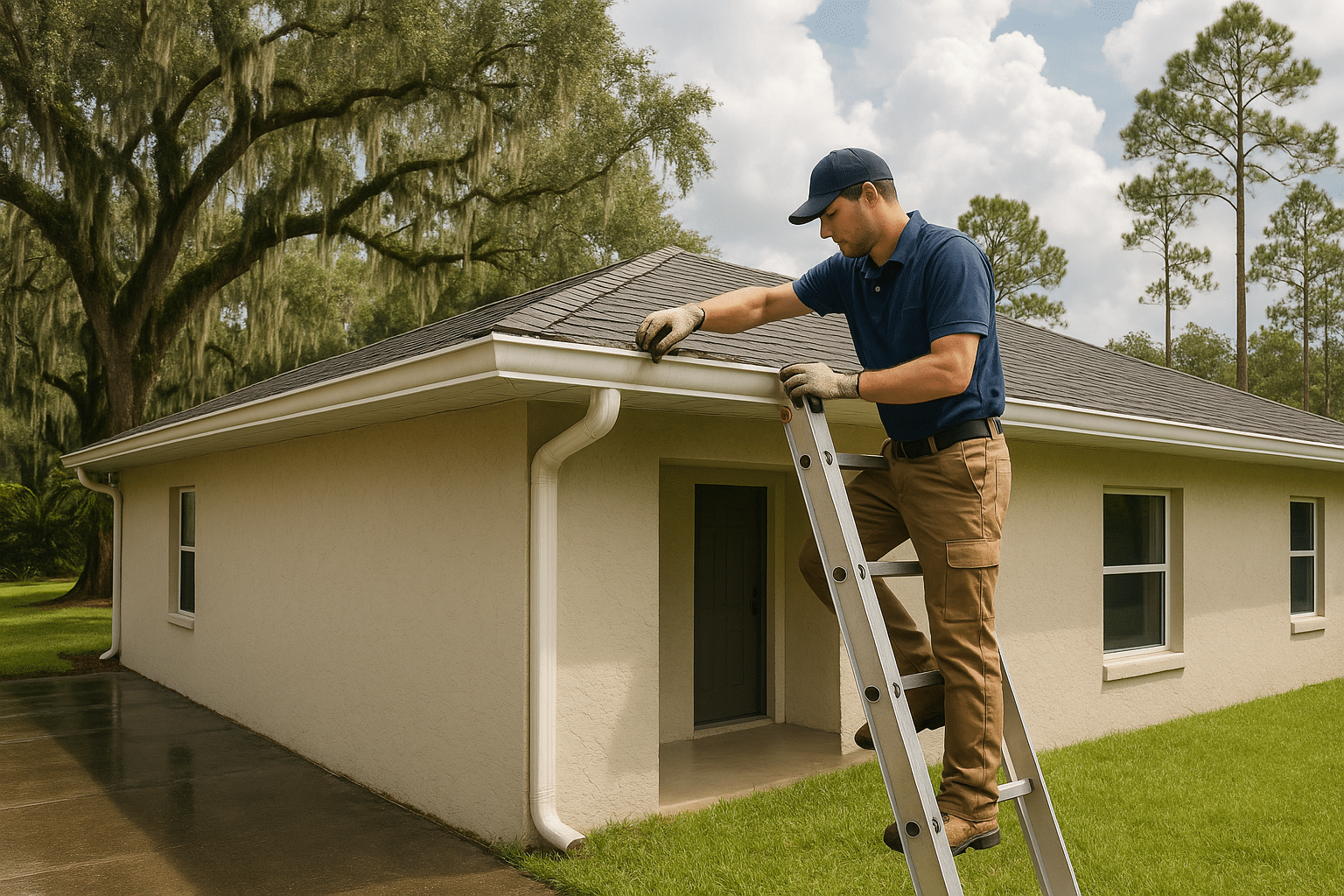
TL;DR: Landlords in Alachua, Archer, Astatula, and Astor carry the legal and financial burden of gutter failures, since most states treat drainage systems as a habitability issue. This guide walks you through a practical inspection-to-repair workflow, seasonal timing around Central Florida’s thunderstorm and hurricane patterns, and the mistakes that turn a cheap cleanout into an expensive insurance claim.
If you own or manage rental property in Alachua, Archer, Astatula, or Astor, your gutters are doing more than keeping water off the porch. They’re protecting your foundation, your siding, your tenants’ belongings, and your liability exposure every time a Central Florida storm rolls through.
Skip gutter maintenance on a rental and the bill usually shows up later as foundation settling, interior water stains, or a mold complaint from a tenant who didn’t cause the problem but is living with it. Here’s how to build a maintenance routine that actually holds up.
Why Gutter Maintenance Is a Landlord Responsibility, Not a Tenant Task
Most landlord-tenant law treats exterior drainage as a structural component of the home, the same category as roofing, siding, and foundation elements, and it falls under the implied warranty of habitability by default.
The landlord’s responsibility extends significantly when it comes to maintaining rental properties, especially concerning structural components like gutters, rooted in the need to keep the property functional and in compliance with local housing codes.
In practice, that means unless your lease has an explicit, clearly written clause shifting gutter cleaning to the tenant, you own the problem.
Unless the lease explicitly states tenant responsibility for gutter cleaning, this duty typically falls to the landlord.
Even when a lease does mention it,
only about 12% of residential leases include such provisions
, so most landlords are on the hook whether they realize it or not.
The financial stakes are real.
Neglected gutter systems cause hydrostatic pressure against foundation walls, generating water damage claims averaging $13,954 per incident
. That’s a significant hit compared to the cost of routine cleaning and inspection.
What Central Florida Landlords Are Up Against
Rental properties in Alachua County and the surrounding areas face a specific combination of conditions that accelerate gutter problems:
- Sandy soil and fast erosion: Overflowing gutters wash out landscaping and undermine foundation footing faster here than in areas with denser clay soils.
- High water tables: Poor drainage around the foundation has less margin for error when groundwater is already close to the surface.
- Afternoon thunderstorms: Intense, short-duration downpours overwhelm undersized or clogged gutters quickly.
- Hurricane season debris and wind-driven rain: June through November brings both heavier rain volumes and more storm debris into the system.
- Live oak, laurel oak, and pine canopy: Year-round leaf drop, Spanish moss, and pine needles keep gutters loading up even outside of a traditional “fall cleanup” season.
Florida’s own building code reflects how central drainage is to protecting a structure:
gutters and downspouts must be constructed of materials compatible with the collection surface, and joints must be watertight
. Code also requires that
condensate lines and roof downspouts discharge at least 1 foot away from the structure sidewall, whether by underground piping, tail extensions, or splash blocks
.
How to Maintain Gutters on a Rental Property: Step by Step
- Put gutter responsibility in writing. Add a specific maintenance clause to every lease stating that gutter cleaning, downspout clearing, and reporting of visible damage are the landlord’s or property manager’s responsibility, with a tenant duty to report overflow or sagging. This protects you in a dispute and gives tenants a clear path to flag problems early.
- Inspect at move-in and move-out. Walk the roofline, photograph the gutters and downspouts, and note any sagging, rust, or separation from the fascia. This creates a paper trail and a baseline condition record for every tenancy.
- Schedule cleanings on a fixed calendar, not a reactive one. In a live oak or laurel oak neighborhood, debris builds year-round, not just in autumn. Set cleanings for spring (before hurricane season) and again in late fall, with a mid-summer check after peak thunderstorm months. If you manage several properties, our year-round gutter maintenance schedule for Central Florida breaks this down month by month.
- Check downspout spacing and discharge points. Standard practice calls for a downspout roughly every 40 linear feet of gutter run, and Florida’s rainfall intensity means gaps are felt fast during a downpour. Confirm each downspout discharges well clear of the foundation, not pooling against the slab where sandy soil and a high water table offer little buffer.
- Look for the five warning signs during every inspection: sagging sections, peeling paint or water streaks on siding, pooling water near the foundation, gutters pulling away from the fascia, and plant growth or standing debris in the trough.
- Repair promptly, not at renewal. A loose bracket or separated seam left alone through one more rainy season often turns into fascia rot or a full gutter replacement. Address it the week it’s found.
- Evaluate gutter guards for high-turnover or hard-to-access properties. If you manage a rental with mature live oaks or Spanish moss, a micro-mesh guard reduces how often you need boots on a ladder. For properties under heavy pine canopy, a reverse-curve guard handles needle loads better than mesh alone. Either option cuts the number of emergency callouts between tenants.
- Build a post-storm inspection into your hurricane plan. Clear debris and confirm drainage before hurricane season starts and again after any named storm passes through the area. Damage from debris impact or wind-driven rain is often not visible from the ground.
- Keep dated records and receipts. Maintenance logs, photos, and invoices support your position if a tenant disputes responsibility or files a claim related to water intrusion, and they help with insurance claims after storm damage.
- Use licensed, insured contractors and verify workmanship guarantees. For a rental, the goal is a system that performs for multiple tenancies with minimal callbacks, not the cheapest one-time clean.
What You’ll Need
- A written lease clause assigning gutter responsibility
- A ladder-safety plan or licensed contractor for inspections above single-story height
- A basic inspection checklist (sagging, pitch, seams, downspout discharge, debris)
- A maintenance log or property management software to track service dates
- A relationship with a local gutter contractor who knows the area’s tree canopy and storm patterns
Common Mistakes Landlords Make
- Assuming the tenant will handle it. Without an explicit lease clause, courts and housing authorities generally default to the landlord.
In most cases, renters are not responsible for cleaning the gutters. - Waiting for a tenant complaint. By the time a tenant notices water coming through a ceiling or wall, the damage is often already done.
Over-flowing gutters, pulled away fascias and foundation damage caused by gutters would all be considered to be issues that affect the habitability of a rental property. - Ignoring moisture and mold connections. The EPA is direct about this link:
clean and repair roof gutters regularly, and make sure the ground slopes away from the building foundation so water does not enter or collect around it
. For a rental, an undetected leak behind a wall can become a mold complaint and a habitability claim. - Skipping pre-hurricane-season prep. Clearing gutters before storms hit is a standard recommendation across hurricane preparedness guidance, since
clearing gutters, downspouts, and exterior drainage systems of leaves, twigs, debris, and sediment reduces the risk of roof leaks and flooding issues
. - Treating all properties the same. A rental under heavy oak canopy in Archer needs a different debris plan than a property near sand pine stands outside Astor. Match the cleaning frequency and guard type to the actual tree cover on each lot.
- Deferring repairs to save money between tenants. A small fascia repair now is cheaper than replacing rotted wood and a full gutter run after water sits against it for a season.
When to Bring in a Professional
DIY cleaning works for single-story homes with easy roof access, but most landlords managing multiple units, two-story rentals, or properties with mature tree canopy are better served by a scheduled service contract. A professional crew can also spot early fascia damage, improper pitch, or undersized downspouts that a quick visual check from the ground will miss.
Larry’s Gutters fabricates seamless K-Style aluminum gutters on site, so there are no seams to leak or clog on a rental property, and every install is backed by a Lifetime Workmanship Guarantee, useful protection when you’re managing a property you don’t live in day to day. We also offer scheduled cleaning and repair service across Alachua, Lake, Marion, and Sumter Counties. If you manage rentals in the area, see our gutter cleaning and repair services in Alachua or explore our full range of gutter services across Leesburg and Central Florida to set up a maintenance plan that fits your portfolio.
Recommended Reads
- The Year-Round Gutter Maintenance Schedule Every Central Florida Homeowner Needs
- Gutter Services in Leesburg & Central Florida
- Gutter Cleaning and Repair in Alachua, FL | Larry's Gutters
Sources
- bostonapartments.com
- justanswer.com
- cleanproguttercleaning.com
- windowgenie.com
- weneedgutters.com
- codes.iccsafe.org
