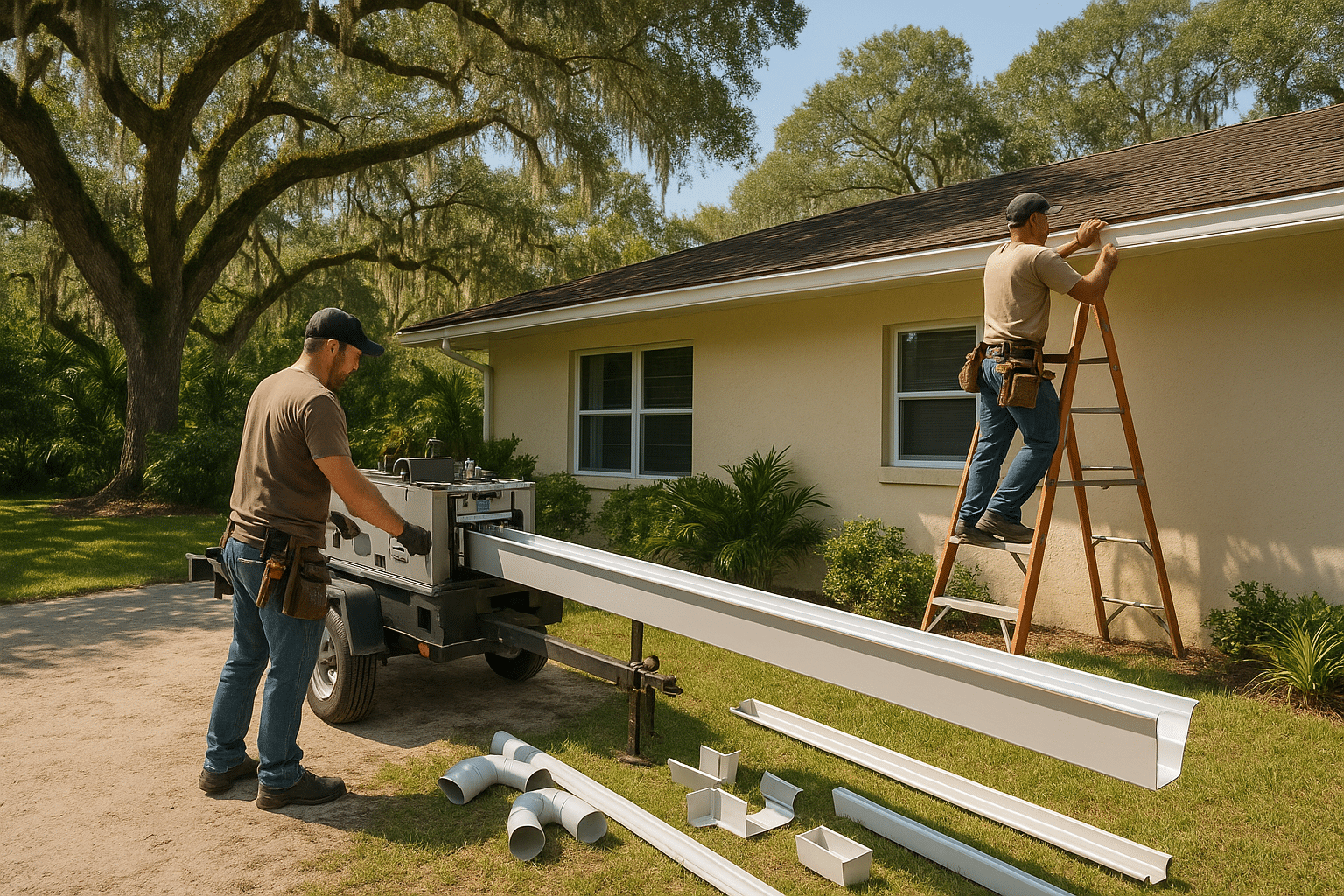
TL;DR: A seamless gutter installation in Central Florida typically wraps up in a single day. The crew fabricates every gutter run on site to a custom length, inspects your fascia, hangs and pitches the gutters, installs downspouts and valley shields, and cleans up before walking you through the finished system. A little prep work on your end — clearing the perimeter, securing pets, and moving vehicles — keeps the job moving safely and on schedule.
You scheduled the estimate, picked your gutter profile, and now installation day is on the calendar. So what actually happens between the time the truck pulls in and the crew drives away?
This walkthrough covers every stage of a seamless gutter installation — what the crew does, what you should do, and what to watch out for — written specifically for Central Florida homes in Alachua, Lake, Marion, and Sumter Counties, where the weather and tree canopy create conditions unlike almost anywhere else in the country.
Why Installation Day Looks Different Here Than in Most of the Country
Thunderstorms are ubiquitous during the Florida summer, and Florida experiences the highest annual number of thunderstorms in the United States. Those storms hit hard and fast. Repeated rounds of slow-moving showers and thunderstorms can produce precipitation totals of over 1 to 2 inches per hour.
That intensity is exactly why Larry’s Gutters installs 6-inch K-style seamless aluminum gutters as the standard here. For high-rainfall regions such as the Gulf Coast, 6-inch K-style is the recognized standard. Five-inch gutters — perfectly adequate in drier climates — simply cannot move water fast enough during a Central Florida afternoon downpour.
Sandy soils in our region also drain quickly on the surface but erode just as fast when a downspout dumps concentrated water in the wrong spot. Getting the discharge locations right matters as much as the gutters themselves.
Before the Crew Arrives: Your Preparation Checklist
You do not need to be home for the entire job, but a few tasks before the crew shows up will save time and protect your property.
- Clear the perimeter. Move patio furniture, plants, and toys at least ten feet away from your walls — installers need this clear path to set up ladders and move materials around the house.
- Move your vehicles. Move your cars out of the driveway and away from the house — this gives the crew a workspace to cut gutter sections and keeps your vehicle safe from any falling debris.
- Unlock all gates. The crew needs access to every side of the home. A locked gate on the back fence will stall the job.
- Secure pets. Keep pets indoors or supervised while ladders are up and the crew is moving around the full exterior, opening gates and accessing all sides of the home.
- Flag delicate landscaping. Point out any irrigation heads, accent lighting, or fragile shrubs near the foundation so the crew can stage ladders away from them.
- Be reachable. While it is not strictly necessary to be home all day, being available by phone in case the crew has questions — and having someone on-site at the beginning and end for a final walkthrough — is genuinely helpful.
How Long Will It Take?
For a standard-sized home, you can usually expect the project to wrap up in a single day — most crews finish in four to six hours. If you have a very large home, multiple stories, or a complex roof with a lot of peaks and valleys, it might stretch into a second day.
Weather is the main factor that can change the schedule — since handling long metal strips on ladders is dangerous during high winds or heavy rain, installers will often reschedule if the forecast is bad. In Central Florida, that usually means keeping an eye on the afternoon storm window. Morning starts are common precisely for this reason.
Step-by-Step: What Happens on Installation Day
-
Arrival and site review
The crew walks the full perimeter with you (or reviews the pre-job notes if you are away). They confirm downspout locations, flag any roof valley points where water overshoots, and agree on where gutter-guard sections will go. Before or at the start of installation, have a conversation with your contractor about where the downspouts will be located — discuss the grade of your yard and any areas where water tends to pool. On sandy Central Florida lots near retention ponds or with a high water table, this conversation directly protects your foundation.
-
Removal of old gutters
Existing gutters and hangers are removed before new installation begins — expect some noise during this phase as old fasteners and sections are pulled. Most professional gutter companies remove and properly dispose of your old gutters — confirm this service is included in your quote. Larry’s Gutters hauls all old material away as part of every replacement job.
-
Fascia inspection and minor repairs
With the old system off, the crew inspects your fascia boards. A quality installer will inspect your eaves and fascia, making any necessary improvements before moving on to the next step of the installation process. Rotted or soft fascia cannot hold hidden hangers securely and must be addressed before new gutters go up. In humid Central Florida, fascia rot is common — especially on older homes shaded by live oaks or laurel oaks that hold moisture against the wood year-round.
-
On-site fabrication of seamless runs
This is the step that sets a seamless installation apart from a sectional one. On installation day, your contractor brings a gutter extrusion machine to your home and custom-fabricates each section from a single piece of material. Seamless gutters are custom-fabricated on-site to fit the exact dimensions of your home, with no joints or seams along the straight runs — this significantly reduces the risk of leaks and clogs compared to traditional sectional gutters.
The portable forming machine runs a coil of aluminum through a set of dies and produces a continuous 6-inch K-style gutter at whatever length the fascia run requires. No field joints means no sealant points to fail. If you want a deeper look at why on-site fabrication outperforms prefab sections, see our guide on on-site gutter fabrication vs. prefab gutters.
-
Setting slope and hanging gutters
Before a single hanger goes in, the crew snaps a chalk line on the fascia to establish the correct pitch. The NRCA Roofing Manual references ¼ inch per 10 feet as the practice standard for K-style gutters, and that is the benchmark Larry’s Gutters uses on every run. Every 10 feet of gutter length requires a slope between a quarter and a half of an inch — a gentle incline that prevents water from pooling and leaking.
Hidden hangers are then driven through the gutter and into the fascia at regular intervals, locking the run in place at exactly the right pitch. Proper hanger spacing matters especially here: hurricanes and intense coastal storms are the most serious weather threats in Florida, with hurricane-force winds impacting the state an average of three times every five years. A gutter system that cannot survive a named storm is not doing its job.
-
Valley shields and miters
Roof valleys — where two roof planes meet — funnel enormous volumes of water in a concentrated stream. Without protection, that stream overshoots the gutter entirely. Larry’s Gutters includes valley shields on every installation to redirect that flow back into the channel before it can arc over the edge and soak your foundation or erode the sandy soil beside your footings.
Inside and outside miters are cut, fitted, and sealed at every corner. Key areas such as miter joints, downspout guides, endcap points, and fastener joints are sealed using a waterproof sealant — typically a durable rubber caulk that effectively resists heat and cold and remains flexible after drying. Florida heat cycles make flexibility essential; rigid sealants crack and leak within a season or two.
-
Downspout installation
Downspouts are positioned roughly every 40 linear feet of gutter run. Consider adding extensions or elbows at the base of each downspout to channel water even further from the foundation — these extensions are practical and allow you to customize how water flows away from your home, with any extension piece sloped away from the foundation at a minimum of 1 inch per 8 feet to promote proper drainage.
On lakefront and waterfront properties, discharge direction is especially important — stormwater ordinances in some Central Florida municipalities govern where runoff can legally exit your lot. Discuss this with the crew at the pre-job walkthrough.
-
Gutter guard installation (if ordered)
If you selected a gutter guard system, it goes on now while the crew already has ladders positioned along the full roofline. Larry’s Gutters offers two systems chosen specifically for Central Florida’s year-round debris load: Hydro-Flo micro-mesh for homes under live oak, laurel oak, and Spanish moss canopy, and Bulldog reverse-curve for longleaf, slash, and sand pine needle loads. Matching the guard to the specific debris type in your yard is what separates a system that stays clear from one that clogs as fast as open gutters.
-
Final inspection and walkthrough
A tidy close-out is part of a professional job — expect debris haul-off, a magnet sweep for stray screws, and photo verification of hanger spacing, corners, and outlets. Before the crew leaves, walk the perimeter with the lead installer. Confirm that every downspout is discharging away from the foundation, that guard sections lie flat with no gaps at the roofline, and that the fascia looks clean and undamaged.
Save your warranty and care notes — after the first big storm, do a quick visual to confirm smooth flow. In Central Florida, you will not wait long for that test.
What You Will Hear and See During the Day
Installing gutters is a noisy process — you will hear power tools, metal clanging, and the crew talking. If you work from home or have pets sensitive to loud noises, it helps to plan for the disruption ahead of time.
You will also see installers moving past your windows on ladders throughout the day. This is normal. The crew needs full-perimeter access and will typically start at one corner and work continuously around the home.
Common Mistakes That Delay or Derail Installation Day
- Blocked access. A locked gate, a parked car under the eave, or a propane grill against the wall can stop the job cold. Clear the perimeter the evening before.
- Skipping the fascia conversation. If you know you have soft fascia, tell the crew before they start. Discovering rot mid-job adds time and may require a return visit for lumber repairs.
- No downspout-discharge plan. Pointing downspouts straight at a sandy flower bed or toward a neighbor’s fence is a problem that is much easier to fix during installation than after. Tell the crew where you do and do not want water to exit.
- Ignoring the weather window. Try to select a dry day with no rain forecasted to ensure optimal conditions for installation. In the June–September storm season, morning scheduling and flexibility with rescheduling keep the project on track.
- Choosing the wrong guard for your tree canopy. A reverse-curve guard under a live oak will pack with Spanish moss and fine debris within months. Tell your estimator exactly which trees overhang the roofline so the right system goes on the first time.
After the Crew Leaves: Your First-Week Checklist
- Inspect the soil at each downspout after the next rain — water should flow away cleanly, not pool.
- Walk the gutter line from the ground and look for any visible sag or section that appears out of slope.
- Check that gutter guard edges are flush against the roofline — wind can lift a section that was not fully seated.
- Save your Lifetime Workmanship Guarantee documentation in a safe place, and note the contact number for Larry’s Gutters if anything needs attention.
A well-installed seamless gutter system in Central Florida is one of the highest-return exterior upgrades you can make — it protects your foundation from sandy-soil erosion, keeps your fascia dry through hurricane season, and reduces the risk of water intrusion around your slab. Getting installation day right is the first step. Understanding why seamless, on-site fabrication outperforms prefab sections will help you ask the right questions before any crew shows up at your door.
Ready to schedule? Larry’s Gutters serves Alachua, Lake, Marion, and Sumter Counties from offices in Gainesville and Leesburg. Every estimate is free with no obligation, and every installation is backed by a Lifetime Workmanship Guarantee. Financing is available. Call or request a quote online today.
Recommended Reads
Sources
