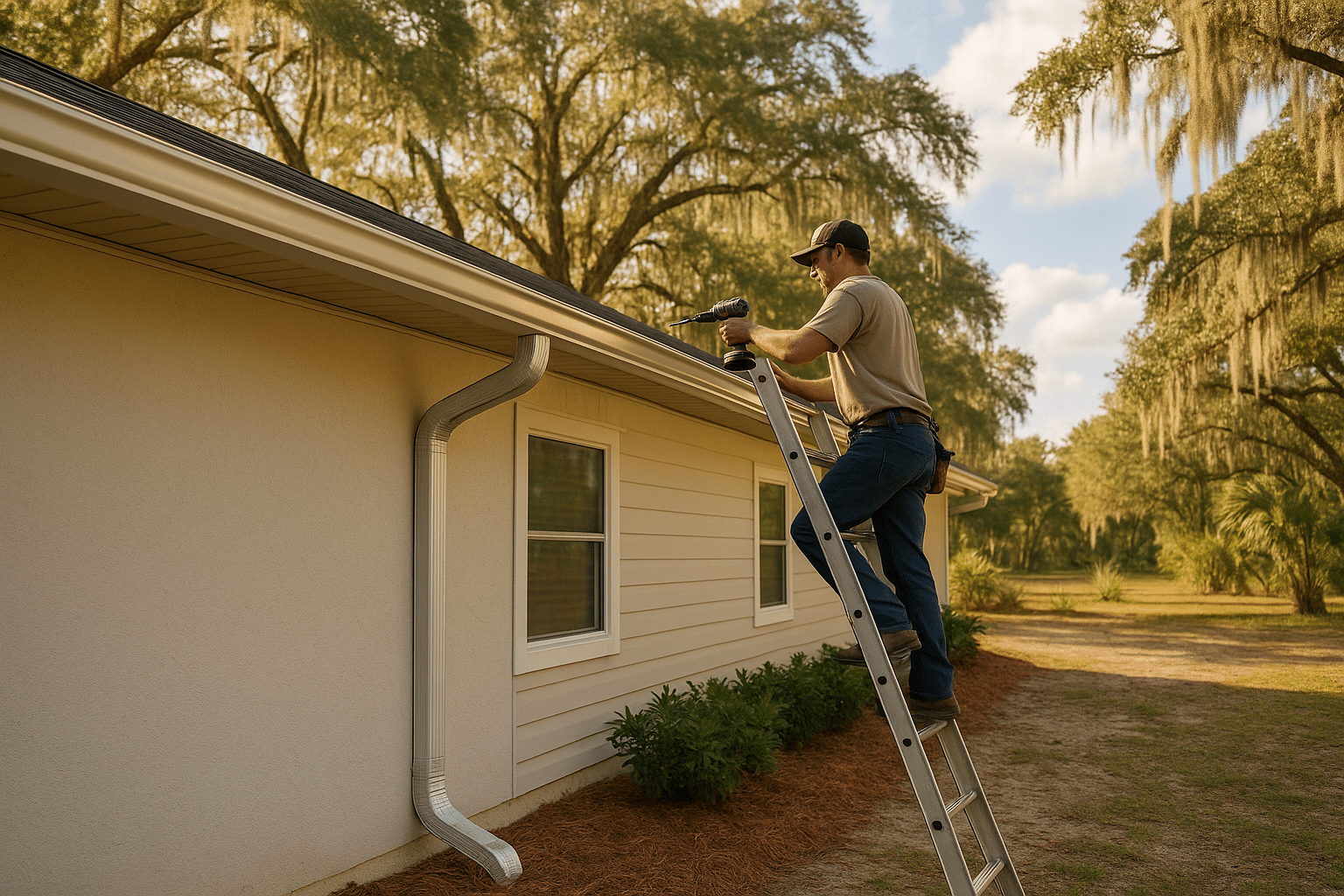
TL;DR: Seamless aluminum gutters in Central Florida typically run $8–$15 per linear foot installed, with most homes landing between $1,100 and $2,200 for a complete system. Florida’s intense summer storms, sandy soil, and year-round debris load make sizing, material, and guard selection just as important as the per-foot price. Get a free, no-obligation estimate from Larry’s Gutters to see exactly what your home needs.
You’ve noticed the drip lines carving trenches in your yard, or maybe you just bought a new home and realized the builder skipped gutters entirely. Either way, you’re now asking the right question: what does it actually cost to install seamless gutters in Central Florida?
The honest answer is that price depends on several variables — but the range is tighter than most national guides suggest for this region. Here’s a clear-eyed breakdown built for Alachua, Lake, Marion, and Sumter County homeowners.
National Baseline vs. Central Florida Reality
Seamless gutters typically cost $8 to $28 per linear foot installed nationally — more expensive than sectional systems, but they reduce leak risk and require less maintenance over time. That wide range reflects everything from basic aluminum on a simple ranch home to copper on a two-story custom build.
For the typical Central Florida home — a single-story, 1,600–2,400 sq ft slab-on-grade with a hip or gable roof — aluminum seamless gutters fall in the $8–$15 per linear foot installed range, which aligns with the K-style category cited by major estimating sources. The average U.S. home requires between 100 and 200 linear feet of guttering; for a standard 2,000-square-foot home needing roughly 200 linear feet, the typical project cost ranges from $1,149 to $1,873.
Florida-specific factors — intense rainfall, sandy soil, hurricane exposure, and dense tree canopy — can push your total toward the upper end of that range. We’ll explain each factor below.
What’s Included in a Seamless Gutter Quote?
A complete installation quote from Larry’s Gutters covers more than just the gutter trough. Here’s what the per-linear-foot price should include:
- On-site fabricated aluminum gutter — formed to the exact length of each fascia run, with no joints
- Hangers and mounting hardware
- Downspouts — one roughly every 40 linear feet
- End caps and miters
- Valley shields — standard at Larry’s Gutters to stop water overshooting at roof valleys
- Labor and cleanup
Downspouts and end caps are essential components that direct water flow away from your home, preventing flooding and foundation damage. Most homeowners spend $5 to $40 per linear foot for downspouts and $3 to $20 per end cap installed. When comparing quotes, confirm these items are included — low per-foot bids sometimes strip out downspouts and hardware.
Why On-Site Fabrication Matters for Pricing (and Performance)
Larry’s Gutters brings a portable roll-forming machine to your property and fabricates each gutter run to the precise length of your fascia. That means zero seams, zero joints, and zero weak points where leaks and clogs start.
Prefabricated sectional gutters are cheaper upfront but require joints every 10–12 feet — each one a future leak point. Over a 5–10 year horizon, the repair and re-caulking costs often exceed the initial savings. Learn more in our guide to on-site fabrication vs. prefab gutters.
The 6-Inch Standard: Why Florida Homes Need More Capacity
Most national pricing guides default to 5-inch gutters. Larry’s Gutters installs 6-inch K-style gutters as the standard for every Central Florida home — and here’s why that matters.
A 5-inch gutter holds about 1.2 gallons of water per foot, while a 6-inch gutter holds roughly 2.0 gallons per foot — that’s 67% more capacity. During a Florida afternoon thunderstorm that can dump 2 inches of rain in under an hour, that difference determines whether your gutter channels the water or pours it over the edge.
Six-inch gutters offer additional protection against heavy rainfall, and for homeowners in areas known for heavy rainfall like Fort Lauderdale, larger gutters in six or even seven inches are ideal. Central Florida’s summer storm season puts the region firmly in that category.
Areas experiencing frequent heavy rainfall or prone to sudden downpours benefit from the additional capacity of 6-inch gutters — if you live in Florida, where annual rainfall is significant, the extra inch can make a crucial difference in preventing overflow.
What Drives the Cost Higher (or Lower) on Your Home
1. Linear Footage
The longer your roofline, the more material and labor is needed. A small 1,200 sq ft cottage may need 120 linear feet; a sprawling 2,800 sq ft lakefront home with multiple roof planes could easily require 220+ linear feet.
2. Number of Stories
Two-story installations require taller ladders and more time to set up safely, which raises the labor component of the per-foot rate.
3. Roof Complexity
Hip roofs — common throughout Central Florida — have more corners and angles than a simple gable roof. Each inside and outside corner requires a custom miter cut and fitting, adding time and material cost.
4. Gutter Guard Add-Ons
Adding a guard system at install time is the most cost-effective moment to do it. Larry’s Gutters offers two systems matched to the local tree canopy:
- Hydro-Flo micro-mesh — engineered for the fine debris from live oaks, laurel oaks, and Spanish moss that is ubiquitous across Gainesville, Ocala, and The Villages area
- Bulldog reverse-curve — designed to handle the high-volume needle drop from longleaf, slash, and sand pine common on rural acreage and lakefront lots
We do not publish guard pricing here because the right system — and its cost — depends on your specific tree canopy, roof pitch, and gutter run lengths. Ask for a line-item quote at your free estimate.
5. Old Gutter Removal
If you’re replacing an existing sectional system, removal and disposal adds to the total. Ask whether it’s included in the quoted price.
6. Fascia Condition
Rotted or damaged fascia board must be repaired or replaced before new gutters can be hung correctly. This is a separate cost, but it’s essential — gutters pull away from soft wood within months.
The Florida Factor: Why Proper Gutters Are Critical Here
Gutters are not universally required by the Florida Building Code for slab-on-grade homes. FBC Residential Section R801.3 states that where roof overhangs do not direct water away from the structure and expansive or collapsible soils are present, a drainage system shall be installed — but the code doesn’t require gutters for most residential properties unless very specific conditions apply.
That code gap is exactly why so many Central Florida homes are sold without gutters. But the absence of a legal mandate doesn’t mean the absence of risk.
With 50 to 65 inches of annual rainfall and a rainy season that concentrates 60% of that between May and October, Florida properties face erosion pressures that many other states simply do not experience — and with hurricane season running June through November, the potential for catastrophic erosion events is a reality every property owner must plan for.
Florida’s sandy soils drain quickly under normal conditions, but repeated saturation from gutter overflow can compromise soil stability and allow settling or shifting. Central Florida’s rainy season delivers storms almost daily for months, and each overflow event adds to the cumulative damage — what looks like minor erosion in June becomes a serious trench by September.
For lakefront and waterfront property owners, that eroded soil doesn’t just threaten your foundation — it flows directly into the water body your home is built around.
What Does a Typical Larry’s Gutters Install Cost?
Because every home is different, we won’t publish a single price. What we can offer is a realistic framework:
- Small home (120–150 linear feet): Estimate $960–$2,250 for gutters alone
- Mid-size home (150–200 linear feet): Estimate $1,200–$3,000
- Larger or multi-story home (200+ linear feet): $1,600 and up, depending on complexity
These ranges reflect 6-inch seamless aluminum with standard downspout placement and valley shields. Guard systems are quoted separately. Financing is available for homeowners who prefer to spread the cost, and all estimates are free with no obligation.
Want to know what installation day actually looks like? Read our step-by-step guide to what happens on gutter installation day.
How to Get an Accurate Quote
- Walk your roofline. Note every eave that needs gutters — not every edge, just the drainage edges.
- Count your stories. Single-story vs. two-story affects labor pricing.
- Identify your tree canopy. Oaks and moss vs. pines vs. mixed — this determines which guard system, if any, makes sense.
- Note any existing damage. Soft fascia, rust stains on siding, or erosion trenches give an installer important context.
- Request a line-item quote. It should show linear footage, downspout count, guard system (if applicable), and removal of old gutters as separate line items.
Larry’s Gutters serves Alachua, Lake, Marion, and Sumter Counties from offices in Gainesville and Leesburg. We’re BBB-accredited, a Rain Gutter Association member, and back every installation with a Lifetime Workmanship Guarantee. Call or click to schedule your free estimate — no pressure, no obligation.
Recommended Reads
- On-Site Fabrication vs. Prefab Gutters: Why Seamless Wins Every Time
- What to Expect on Gutter Installation Day: A Step-by-Step Walkthrough
