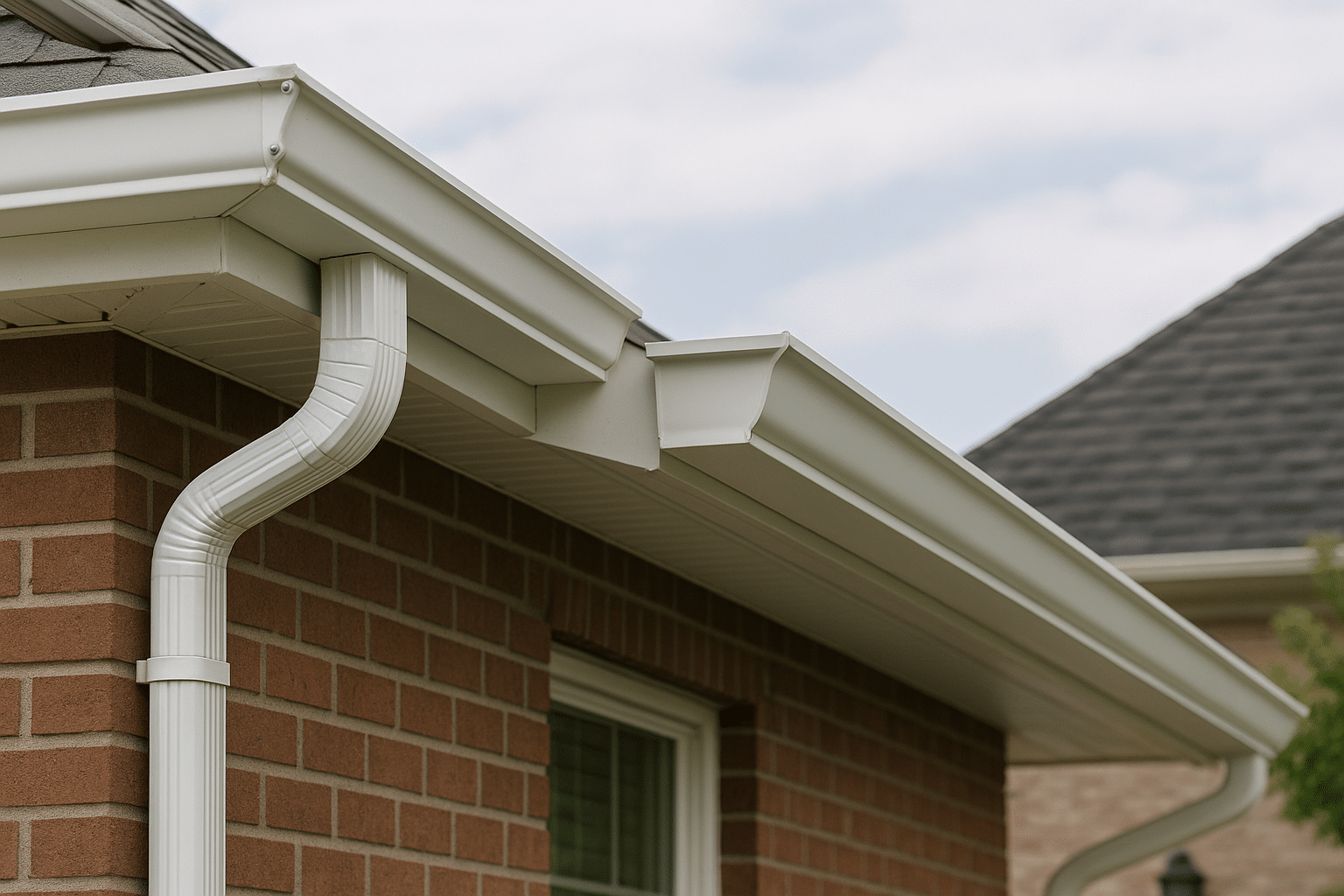
TL;DR: Prefab sectional gutters are joined every 10–12 feet, and every joint is a future leak. On-site seamless fabrication cuts a single continuous run to the exact length of your roofline, eliminating mid-run seams entirely. In Central Florida — where summer downpours are intense, soils erode fast, and debris falls year-round — that difference is the line between a gutter that protects your home and one that quietly damages it.
Walk into any big-box home improvement store and you can buy sectional gutters off the shelf, load them in your truck, and have them up by the weekend. They are cheap, widely available, and look fine on installation day.
They also come with a flaw baked into the design that no amount of caulk can fix permanently: every 10 to 12 feet, there is a joint. And every joint is a future leak.
On-site seamless gutter fabrication solves that problem at the source. This guide explains exactly how each system works, where they differ, and why the distinction matters more in Central Florida than almost anywhere else in the country.
What Are Prefab Sectional Gutters?
Sectional gutters are factory-stamped into fixed lengths — typically 10 or 12 feet — and sold through distributors and home improvement stores. An installer (or a DIYer) buys what the job requires, trims pieces to rough length on site, and joins them end-to-end with connectors and sealant.
A single 40-foot run built from 10-foot stock needs at least three mid-run joints before you even count the corners and the outlet where the downspout attaches.
Scale that to a full home perimeter and
a sectional system installed on a typical home may have 15–25 seams depending on perimeter length.
The One Structural Weakness You Cannot Seal Away
Seams are the most common failure points in gutter systems. Sectional gutters rely on multiple joints sealed together, which can separate, crack, or leak over time.
The aluminum or steel itself is rarely the weak point in a sectional system.
It is the sealant.
Every connector joint is a seam, and every seam is a potential failure point. Sealant degrades over time — faster in heat — and joints that looked tight at installation begin to separate, weep, and eventually leak.
Each one requires periodic inspection and resealing to maintain performance. Over a 10–15 year period, the cumulative maintenance cost of a sectional system frequently exceeds the price premium of seamless at installation.
What Is On-Site Seamless Gutter Fabrication?
Seamless gutters are fabricated on site from a single continuous coil of aluminum using a portable roll-forming machine. The machine is brought to your driveway, fed with a coil of pre-painted aluminum, and produces a custom gutter run cut to the exact length of your roofline.
The only joints in the entire system are at corners and downspout outlets — the gutter itself has zero seams.
That is not a marketing claim. It is a direct result of how the product is made.
At Larry’s Gutters, our crews bring the forming machine to each home in Alachua, Lake, Marion, and Sumter Counties. Every run is measured, then extruded on the spot to the exact fascia length — no factory offcuts, no mid-run connectors, no guesswork.
Side-by-Side: How the Two Systems Compare
- Leak points:
In a standard 150-foot gutter run, a sectional system typically has between 15 and 20 joints, each relying on rubber gaskets or chemical sealants. A seamless system for that same 150-foot run would only have 4 to 6 joints — exclusively at the corners and the downspout outlets. - Clog risk:
By eliminating most seams, seamless gutters reduce the risk of leaks, clogs, and debris buildup, resulting in more reliable water flow.
Debris snags at joints; with no mid-run joints, it has nowhere to pile up. - Appearance:
Seamless gutters result in a smooth, uniform appearance and improved performance.
There are no visible connector ridges breaking the roofline. - Maintenance:
Sectional gutter systems require more frequent attention — resealing, realigning, and unclogging joints — especially after heavy rain or extreme weather. - Upfront cost:
Seamless gutters typically cost more upfront than traditional sectional gutters because they require professional installation and on-site fabrication.
That gap narrows quickly once you account for avoided repairs. - Installation: Seamless gutters cannot be DIY-installed.
Seamless gutters are the professional installation standard. The equipment required to fabricate them means they cannot be DIY-installed from off-the-shelf materials, which is why sectional gutters persist as a retail option.
Why This Matters More in Central Florida
The seamless-vs-sectional debate plays out everywhere, but the stakes are higher here. Central Florida’s climate accelerates every failure mode that sectional joints are prone to.
Intense Rainfall Loads the System Hard
Intense storms in Central Florida can dump two inches of rain per hour, creating rapid runoff volumes.
A gutter here is not lightly damp — it is moving serious volumes of water in short, violent bursts. Every leaking joint is a spot where that water escapes onto your fascia exactly when the system is under the most load.
Florida Building Code requires gutter systems to be sized for significant rainfall intensity.
The expected rainfall intensity can be found in NOAA’s detailed precipitation frequency estimates
— and Central Florida’s numbers are among the highest in the continental U.S. Our standard 6-inch K-style gutters are sized specifically for these volumes; a standard 5-inch sectional system sold at retail is often undersized for Florida storms before the joint failures even begin.
Sandy Soil Punishes Every Drip
A leaking gutter joint does not drip harmlessly into a lawn.
When a gutter joint lets go, the water runs down behind the gutter, soaks the fascia board, and rots the wood your gutters are screwed into. By the time you see a stain on the soffit, the damage is already done.
And what hits the ground matters, too.
In sandy soils, gutters play a crucial role in protecting the foundation. Sandy soils are highly porous and prone to erosion, especially during heavy rainfall. When rainwater is not properly diverted away from the foundation, it can cause the soil to expand and contract, leading to foundation instability.
In Florida, where the water table can be high, standing water can increase the pressure on the foundation.
Poor gutter drainage remains one of the most common and preventable causes of foundation problems in Florida.
A leaking joint directly overhead is a slow, invisible contribution to that problem.
Learn more about how downspout placement affects soil stability in our guide to gutter downspout placement and soil erosion.
Thermal Cycling Destroys Sealant Fast
Sealant in a northern climate might last years before the freeze-thaw cycle cracks it. In Florida, the stressor is heat. Aluminum expands and contracts with every temperature swing between a cool morning and a 95°F afternoon.
Over time, thermal cycling — the constant expansion and contraction of materials as temperatures change — causes these joints to shift. In sectional gutters, this stress eventually breaks the sealant bond, leading to the drip that can rot your fascia boards or erode your landscaping.
Year-Round Debris Loads Are Heavy
Central Florida’s tree canopy never fully drops its leaves the way northern forests do. Live oaks, laurel oaks, and longleaf and slash pines shed needles, leaves, and seed pods continuously. Spanish moss collects in valleys and valleys overflow. Debris that catches on a sectional joint builds into a dam; in a seamless run, there is nothing for it to snag on between the downspouts.
That is why Larry’s Gutters pairs seamless systems with two guard options matched to local debris: Hydro-Flo micro-mesh for oak-leaf and Spanish moss loads, and Bulldog reverse-curve for pine needle-heavy lots. Guards extend clean-out intervals — but the seamless channel underneath means when water does run, it runs clean.
When Does Sectional Make Sense?
Fairness demands an honest answer.
Small runs in protected spots — a short gutter on a covered porch or under a sheltered overhang — see minimal stress, and sectional gutters hold up fine in those locations.
For a small outbuilding, a shed, or a very short supplemental run in a protected area, the lower material cost of sectional may be appropriate.
For any full residential or commercial roofline — especially in Florida —
many homeowners view seamless gutters as a better long-term value. Fewer seams mean fewer leak-prone joints, reduced maintenance needs, and a longer overall lifespan compared to sectional systems.
What a Professional On-Site Installation Looks Like
When Larry’s Gutters arrives at your home, here is what happens:
- Measure the fascia — every run is measured for length, pitch, and the location of roof valleys.
- Load the coil — a pre-painted aluminum coil goes into the portable roll-forming machine in your driveway.
- Extrude the run — the machine forms the exact K-style profile and cuts the run to the precise fascia length in one continuous piece.
- Install the run — hangers are set at the correct pitch for drainage, and downspouts are planned roughly every 40 linear feet to handle Florida’s rainfall intensity.
- Add valley shields — valley shields are installed at every roof valley to stop water from overshooting the gutter during heavy downpours.
- Seal only where joints exist — corners, end caps, and downspout outlets get a professional seal. That is it.
Every installation is backed by Larry’s Gutters’ Lifetime Workmanship Guarantee, and financing is available for qualifying homeowners.
The Bottom Line
Seams are where gutters fail. Joint sealants dry out, gaskets crack, and stress works its way into every connection. By eliminating the connectors entirely along straight runs, seamless gutters remove the most common failure points before installation even begins.
In Alachua, Lake, Marion, and Sumter Counties — where summer thunderstorms are violent, soils are sandy and quick to erode, and debris falls twelve months a year — a gutter system with 15 to 25 joints is not a small compromise. It is a maintenance schedule and a foundation risk you signed up for without realizing it.
On-site fabrication costs a little more on day one. It costs considerably less over the life of the home.
Ready to see the difference? Request a free, no-obligation estimate from Larry’s Gutters — we serve both Gainesville and Leesburg, and we bring the machine to you.
