TL;DR: Most gutters need a fascia board, or at least solid wood at the roof edge, because the hangers screw through the fascia into the rafter tails. Homes with no fascia can still get gutters using roof-mounted straps. If the fascia is rotted, it has to be fixed before new gutters go up.
Yes, in most cases gutters need a fascia board, or at least solid wood at the roof edge to fasten into. Standard K-style gutters hang from hangers screwed through the fascia and into the rafter tails behind it. If your house has no fascia, or the fascia is rotted, the fix is roof-mounted straps or repairing the wood first.
So do gutters need a fascia board on your Leesburg home? Usually, yes. But the more useful question is whether your fascia is solid enough to hold them. Afternoon thunderstorms, high humidity and hurricane-season wind all test the spot where the gutter meets the house. This guide covers what fascia does, how gutters attach with and without it, and what to check before new gutters go up.
What does a fascia board do for your gutters?
The fascia board is the flat trim board that runs along the roof edge and covers the ends of the rafters or trusses. For gutters, it is the mounting surface. On a typical K-style install, a hidden hanger clips inside the gutter. A screw runs through the back of the gutter, through the fascia, and into the framing behind it.
That framing is what really carries the weight. Fine Homebuilding notes that gutters are less likely to pull free when hangers are fastened into the framing behind the fascia or roof sheathing. The same source says gutter sections need hangers at least every 32 inches. Think of the fascia as trim and the rafter tail as structure.
This matters more with bigger gutters. A 6-inch gutter sized for Florida downpours holds more water than a 5-inch one, so every hanger and every screw has more work to do during a summer storm.
Do gutters need a fascia board on every house?
No. Fascia is the most common way to mount gutters, but not the only way. Fine Homebuilding groups hangers into two types: fascia-mounted hangers that fasten to fascia boards or rafter tails, and roof-mounted straps nailed to the roof sheathing. Roof straps are the only option when a house has no fascia.
You’ll find no-fascia rooflines on some older homes in our area. Think river cabins along the St. Johns in Astor, older farmhouses on acreage outside Archer, and porches where the rafter tails were left exposed for looks. These homes can still get gutters. The mounting method just changes.
| Mounting method | How it attaches | Best for | Watch out for |
|---|---|---|---|
| Hidden hangers on fascia | Screw goes through the gutter back and fascia into the rafter tail | Most homes with a flat, solid fascia | Needs sound wood; will not hold in soft or rotted fascia |
| Roof-mounted straps | Strap nails to the roof sheathing; gutter hangs below the roof edge | Homes with no fascia board | Easiest during a reroof, when straps can go under the shingles |
| Straps on exposed rafter tails | Strap nails to the top of each rafter, then gets flashed over | Open-eave porches and older cabins | Flashing is needed over the straps to keep rot out |
| Spike and ferrule | Long spike driven through the gutter face and into the fascia | Older systems you may already have | Large holes can invite rot, and spikes tend to loosen over time |
What if my fascia board is rotted?
Rotted fascia has to be repaired or replaced before new gutters go on. A screw cannot grip soft wood. A new gutter hung on a bad board will sag or pull loose, often in the first big storm.
Central Florida is hard on wood trim, and moisture is the main reason. UF/IFAS links dampwood termite problems to sources of free water, including roof leaks and wood left exposed to rain. UF/IFAS also lists fascia boards among the places drywood termites turn up in Florida homes. A clogged gutter that spills onto the fascia every afternoon in July is exactly that kind of water source.
Signs your fascia needs attention before any gutter work:
- Soft spots when you press the wood with a screwdriver
- Peeling, bubbling or flaking paint along the roof edge
- Dark stains or streaks on the fascia behind or below the gutter
- Hangers backing out, or a gap between the gutter and the board
- Water dripping behind the gutter instead of flowing into it
- Small piles of pellets or tiny holes in the trim, which can point to termites
If only a few spots are bad, a spot repair may be enough. If whole runs are soft, plan on new fascia. Our guide on choosing between gutter repair and full replacement helps you think through the gutter side of that decision.
How does Central Florida weather raise the stakes?
Our weather puts more stress on the gutter-to-fascia connection than many parts of the country do. Three things stand out.
Heavy summer rain. Afternoon storms can fill a gutter in minutes. If water can’t reach a downspout fast enough, it spills over the back and soaks the fascia. On our sandy soil, that overflow also lands at the foundation and washes out the sand.
Hurricane-season wind. The roof edge is where wind grabs first. The Florida Building Code, Residential requires drip edge at the eaves and gables of shingle roofs. Where the design wind speed is 110 mph or more, it must be fastened every 4 inches instead of every 12. Drip edge helps direct water away from the fascia, so it works hand in hand with your gutters.
Year-round debris. Live oak leaves, Spanish moss and pine needles clog gutters, and clogs mean overflow onto the wood. In neighborhoods under oaks and moss, a micro-mesh guard fits best. On lots where pines drop most of the debris, a reverse-curve guard fits better. Either way, a steady year-round gutter maintenance schedule keeps water in the gutter and off the fascia.
Why Larry’s Gutters fits fascia-mounted installs
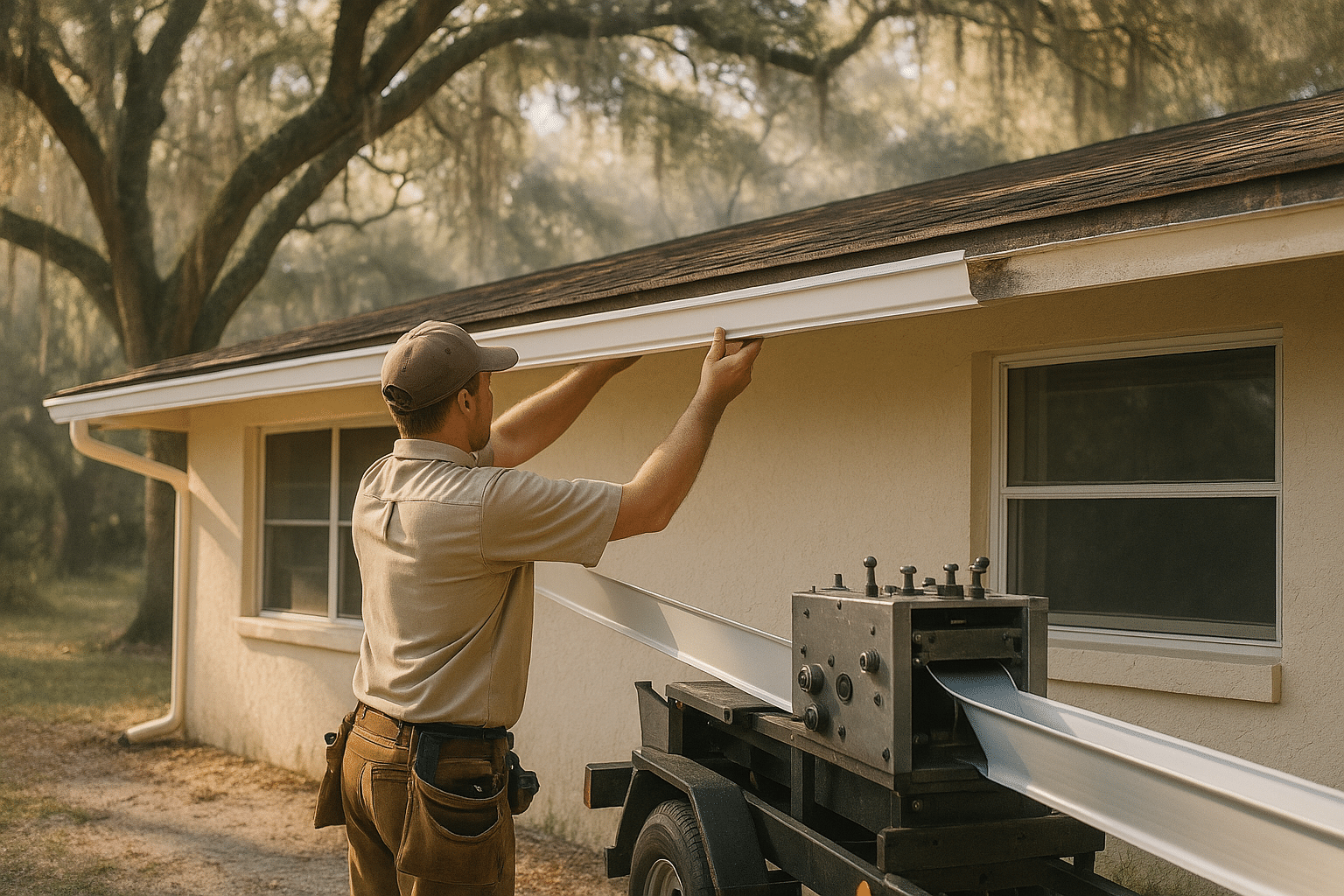
We fabricate K-style gutters on site at each home, cut to the exact length of your fascia, with no joints along the run to drip onto the wood.
Standard installs use 6-inch gutters, with downspouts planned roughly every 40 linear feet.
Valley shields come with every standard install, so water doesn’t overshoot the gutter at roof valleys and soak the trim.
We match gutter guards to your trees: Hydro-Flo micro-mesh for live oak, laurel oak and Spanish moss, and Bulldog reverse-curve for longleaf, slash and sand pine needles.
We also handle gutter cleaning, realignment, repair and emergency clean-outs after storms.
Larry’s Gutters is BBB-accredited and a Rain Gutter Association member.
Every installation is backed by a Lifetime Workmanship Guarantee.
Financing is available, and every estimate is a free quote with no obligation.
We serve Alachua, Lake, Marion and Sumter Counties from offices in Leesburg and Gainesville.
Wondering whether your fascia is ready for new gutters? Call Larry’s Gutters at (352) 460-0450 or get a free quote, and ask about your roof edge when we come out to measure.
Frequently Asked Questions
Can gutters be installed over aluminum or vinyl fascia wrap?
Yes, as long as there is solid wood under the wrap. The wrap is only a thin cover, so the hanger screws have to reach sound fascia and framing behind it.
Should I replace my fascia before or after getting new gutters?
Before. If you replace the fascia later, the gutters have to come off and go back up, which adds work and can damage the gutters.
Is a new roof a good time to add gutters to a house with no fascia?
Often, yes. Roof-mounted straps are easiest to install when they can be nailed to the sheathing and covered by the new shingles, so plan the gutters with your roofer.
How can I tell if my gutters are pulling away from the fascia?
Look for a gap between the back of the gutter and the board, hangers backing out, sagging sections, or water dripping behind the gutter during rain. Catching it early can mean a realignment instead of a bigger repair.
Recommended Reads
- 6-Inch vs. 5-Inch Gutters: Which Size Do Florida Homes Really Need?
- Gutter Repair vs. Full Replacement: How to Know Which One You Need
- Dealing With Slash Pine and Sand Pine Needles? Here’s the Best Gutter Guard Solution
